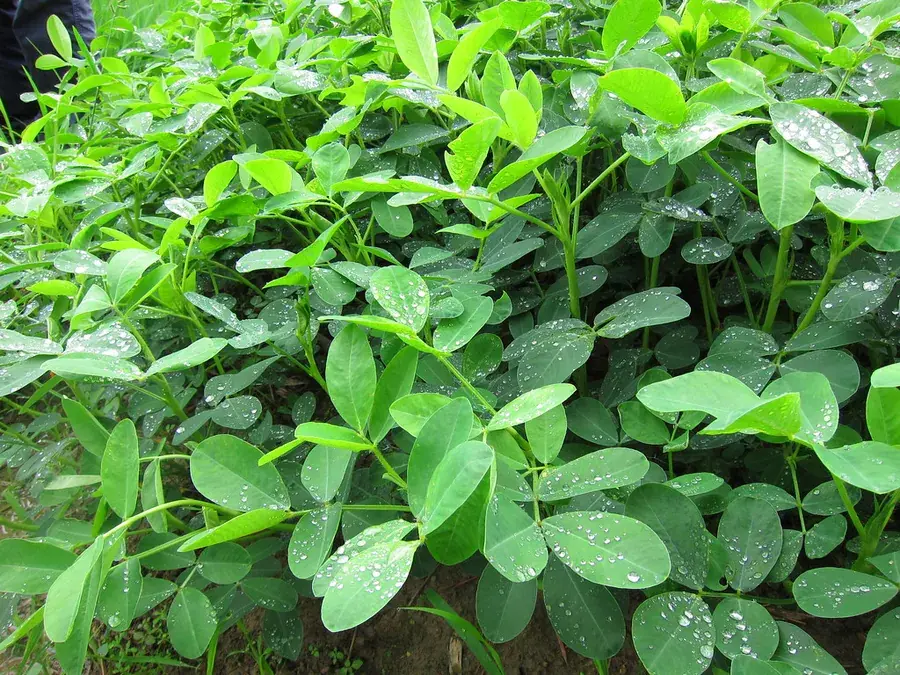
Groundnuts (peanuts)
Arachis hypogaea
Flowers above ground, nuts below — a hot-season legume that wants loose sandy soil and a dry spell to finish.
- Signs of ripeness
- Pull up one plant and open a dozen pods: they are ready when the inside of most shells has turned from white to brown or blotched black and the seed coats have gone pink or tan — harvest when 60–80% of the pods look like that. Valencia types grown for boiling can be dug green from about 75 days; Spanish types take about 120 days, and runner and Virginia types 135–155.
- Harvesting
- Loosen the soil along the row with a fork, then lift whole plants by the base and shake off the soil; pods snapped off and left in the ground are lost. Lift in dry weather, never after rain.
- Curing
- Cure the whole plants before picking off the pods: pile them loosely or hang them, pods upward, in warm, dry, airy conditions for 5–10 days with no rain on them, until the pods rattle. Then pick the pods and finish drying them to about 10% moisture — shells brittle, kernels firm but not shrivelled. Fast, thorough drying is the main defence against aflatoxin, the liver-damaging poison made by Aspergillus moulds on damp groundnuts.
- Frost tolerance
- Groundnuts are frost- and cold-sensitive, and growth stops when the temperature falls below about 15 °C. A frost kills the tops and stops the pods filling; if one is forecast and most pods are mature, lift the plants that day and cure them under cover.
Storage
Storing groundnuts (peanuts)
| Where | Temperature | Humidity | Keeps | How |
|---|---|---|---|---|
| Cool, dry, ventilated cupboard or store, in the shell | 10–20 °C50–68 °F | dry | Several months | Cured pods in mesh or cloth bags with air moving around them: ventilation stops moisture building up, which is what lets moulds and aflatoxin develop. Shell only what you will eat within a few weeks. |
Preserving
Preserving groundnuts (peanuts)
Drying is the method. Cured groundnuts dried to about 10% moisture and kept cool, dry and ventilated store for months. To finish them at home, dry shelled or unshelled nuts in a single layer at 54 °C (130 °F) until the shells are brittle and the kernels tender but not shrivelled; to roast, give them 150 °C (300 °F) for 30–40 minutes in the shell or 20–25 minutes shelled, stirring often. Green — freshly dug, undried — groundnuts for boiling can be pressure-canned in brine by the tested NCHFP method: three one-hour soaks in fresh water, 10 minutes’ parboiling, a brine of 1 cup of salt to 3.8 L (1 gallon) of water, then 45 minutes for 500 ml jars or 50 minutes for litre jars at 10 lb weighted gauge; never water-bath them. The rule that matters most is to throw away mouldy, discoloured or shrivelled nuts rather than eat or press them: aflatoxin is invisible, has been linked to liver cancer in Africa, and can contaminate small-scale, unrefined groundnut oil.
A dehydrator or a low oven; light, keeps for a year.
Two weeks of warmth and air that turn a fresh crop into a keeper.
Jars heated above boiling under pressure — the only safe way to can plain vegetables.
Seed saving
Easy to save: comes true from seed
Groundnuts are self-pollinating, with only occasional crossing by bees, so a variety comes true. Keep the best fully mature pods from healthy plants, store them in the shell, and shell them by hand only one or two weeks before sowing; plant raw, never roasted, kernels. Spanish and Valencia types have no seed dormancy and can sprout in the ground if harvest is held up by rain, while Virginia types are dormant for one to three months.
Keeps: Sow the following season, from seed kept in the shell, cool and dry. Mouldy or aflatoxin-damaged seed germinates poorly and gives weak seedlings.
Seed saving →Next year
Planning groundnuts (peanuts) for next season
Rotate: groundnuts in the same bed no more than one year in three, and not straight after cotton or tobacco, to limit soil-borne disease and nematodes. Deep, loose, well-drained sandy loam with calcium is what they want; on poor soil, apply gypsum beside the row once the plants flower, because the developing pods take calcium straight from the soil around them, and calcium shortage gives empty shells. Sow raw seed 4–7 cm deep, about 10 cm apart in rows 60–75 cm apart, into soil above 15 °C; germination is best at 25–30 °C. Keep weeds out for the first six weeks, then stop hoeing deeply once the pegs go into the soil. In the West African savanna sow with the first reliable rains so the crop finishes into the dry season; in East Africa with the long rains; in summer-rainfall southern Africa from October to December; around the Mediterranean in May. In Ontario only the early Spanish and Valencia types reliably mature.
Groundnuts (peanuts) at a glance
- Botanical name
- Arachis hypogaea
- Group
- Peas and beans
- Picked
- September, October
- Frost
- Tender: finished by the first frost.
- Best put up as
- drying, curing, pressure canning
- Seed
- Easy to save: comes true from seed
Questions people ask about groundnuts (peanuts)
How do peanuts grow underground?
The yellow flowers bloom above ground; once one is pollinated, a stalk called a peg grows down from its base and pushes into the soil, and the pod forms at its tip. That is why groundnuts need loose soil and why you stop hoeing deeply once pegging begins.
When do you harvest groundnuts?
When 60–80% of the pods on a test plant have darkened inside the shell and the seed coats have turned pink or tan — about 120 days for Spanish types and 135–155 days for runner and Virginia types. Valencia types for boiling can be dug green from about 75 days.
What is aflatoxin, and how do I avoid it?
Aflatoxin is a poison made by Aspergillus moulds that invade groundnuts left damp, and it has been linked to liver cancer. Avoid it by lifting in dry weather, curing quickly, drying the nuts to about 10% moisture, storing them where air moves, and throwing away any nut that is mouldy, discoloured or shrivelled.
Can I grow peanuts in Ontario?
Yes, with an early Spanish or Valencia variety. Commercial production needs at least 3,000 crop heat units; gardeners sow in mid-May into soil above 15 °C and harvest from late September to early October, 100–120 days later. A sandy, warm bed makes the difference.
How do you make boiled peanuts that keep?
Use freshly dug green peanuts, soak them three times for an hour in fresh water, parboil 10 minutes, pack into jars with boiling brine (1 cup of salt per gallon of water) and pressure-can 45 minutes for 500 ml jars or 50 minutes for litre jars at 10 lb weighted gauge. There is no safe water-bath method.
How do you roast peanuts at home?
Spread dried peanuts in a shallow pan and roast at 150 °C (300 °F) — 30–40 minutes in the shell, 20–25 minutes shelled — stirring often so they do not scorch. Dry them first at a low heat if they are freshly dug.
Local frost dates
Harvest timing for a place
Enter a town, postal code or ZIP to build the garden year, the frost forecast and this week’s guide from local weather.
Also in peas and beans
 Half-hardyPeas and beansHarvest Jun–Oct
Peas
The first sowing of the year and the first thing in the freezer — pick them every day or they turn to starch.
Freezing · Drying · PressureHarvest and storage → TenderPeas and beansHarvest Jul–Sep
Green beans
Pick them young and pick them often — and never, ever water-bath a jar of plain beans.
Freezing · Pressure · PicklingHarvest and storage → TenderPeas and beansHarvest Sep–Oct
Dry beans
The crop that stores itself: leave the pods to rattle, shell them on the step, and eat them in February.
Drying · Pressure · FreezingHarvest and storage →
Checked against these sources ·
- PROTA (Pl@ntUse): Arachis hypogaea
- UF/IFAS Gardening Solutions: Peanuts
- OMAFRA Specialty Cropportunities: Peanuts
- NCHFP: Drying peanuts
- NCHFP: Canning green peanuts
- FAO ECOCROP: Arachis hypogaea data sheet
Harvest months are typical for zones 4–6 and shift by weeks north and south. Storage figures assume ideal conditions; without a cold store, expect the shorter end of each range.