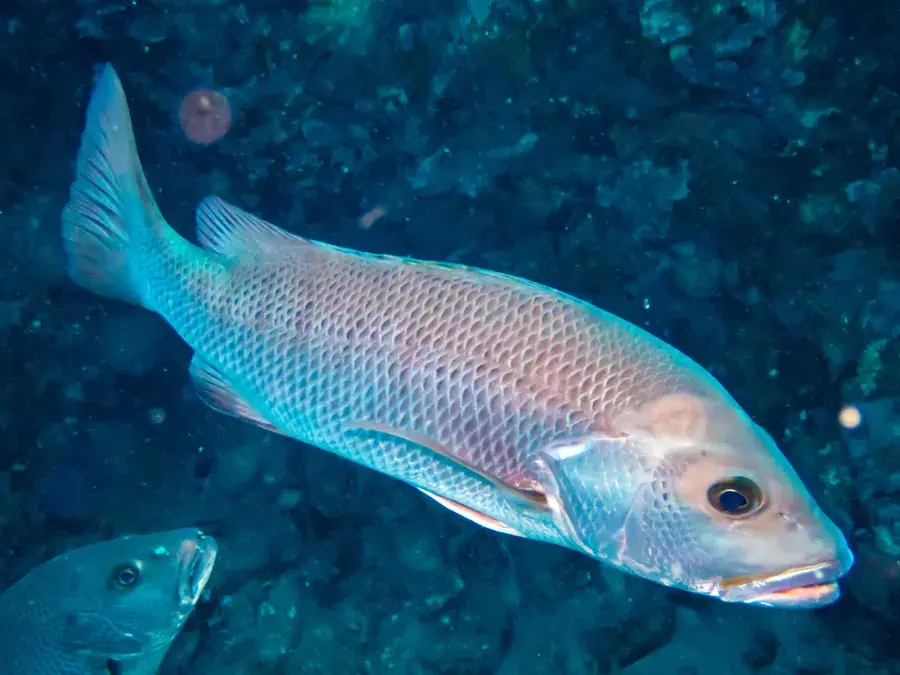
Mangrove red snapper (river snapper)
Lutjanus argentimaculatus
- When
- Active all year; habitat and behaviour shift with the season.
- Habitat
- Mangrove creeks, rocky estuary banks, harbour walls and snags for the young fish — the creeks of the Kenyan and Tanzanian coast, Mozambique’s estuaries, and Kosi Bay, St Lucia and the other KwaZulu-Natal estuaries — and coral and rocky reefs down to 100 m and more, fished from boats, for the big adults.
- Identification
- A heavy snapper, greenish-brown to bronze on the back and reddish on the sides — fish from deep water are red all over — with a silvery or whitish belly and prominent canine teeth. Young fish carry about eight pale bars on the sides and two blue lines across the cheek.
- Notes
- The river snapper or rock salmon of South African estuary anglers and the mangrove jack of Australia: an ambush predator that lies under mangrove roots, ledges and fallen trees, hunts mostly at night and bolts for cover the moment it takes. Young fish grow up in estuaries, even in fresh water, and move out to offshore reefs as they mature.
- Method
- A live mullet or prawn, or a lure or soft plastic cast tight to mangrove roots and rock ledges, on strong line with the drag locked — the first few seconds decide it.
- Caution
- In South Africa five a day at 40 cm or more, on a DFFE recreational permit (online or at the Post Office), and it may not be sold. Ciguatera has been reported — ask locally before eating a big reef fish. No fishing in Kenya’s marine national parks.
Seasons, size limits and catch limits change every year and differ by water body. Check the current regulations for the country and the water before fishing.
Mangrove red snapper (river snapper) facts
- Also called
- River snapper, rock salmon or river roman in South Africa; mangrove jack in Australia; also mangrove snapper, red snapper and red bream.
- Family
- Lutjanidae, the snappers.
- Native range
- The tropical Indo-West Pacific: from the Red Sea and Persian Gulf down the East African coast to South Africa — estuaries as far south as Gqeberha (Port Elizabeth) — and east to Samoa and the Line Islands, north to the Ryukyus and south to Australia. It has reached the eastern Mediterranean through the Suez Canal but is not established there.
- Habitat
- Juveniles and young adults live in mangrove estuaries, tidal creeks and the lower reaches of rivers, among rocks and mangrove roots, where they tolerate very low salinity. Adults move out to coral and rocky reefs down to 80–120 m (260–400 ft).
- Water temperature
- Tropical to subtropical. AquaMaps puts its preferred surface water at about 23–29°C (74–85°F); FishBase gives a range of 16–30°C.
- Size
- Most adults 40–80 cm (16–31 in); the largest measured about 150 cm (59 in).
- Record
- IGFA all-tackle world record: 11.62 kg (25 lb 9 oz), Takuya Kano, Ashizuri Misaki, Kochi, Japan, 3 May 2006. South African records are heavier: 14.1 kg (31 lb) on shore tackle and 16.6 kg (36 lb 10 oz) by spearfishing.
- Lifespan
- Long-lived: aged to 31 years in Papua New Guinea and up to 39 years off eastern Australia.
- What it eats
- Mostly at night: mullet and other baitfish ambushed from under ledges and mangrove roots in estuaries; on reefs, small fish, crabs and crayfish.
- Spawning
- At sea on offshore reefs — off northern KwaZulu-Natal and Mozambique, it is thought, in South African waters — in the southern spring and summer, October to March in Queensland, and through the year nearer the equator. Spawning peaks around the full moon. In Queensland males mature at about 47 cm and females at 53 cm fork length.
- Young fish
- Thirty to fifty days after hatching, juveniles of 2–5 cm move into mangrove estuaries and the lower reaches of freshwater streams. They carry about eight pale bars on the sides and two blue lines across the cheek.
- Teeth and mouth
- Prominent canine teeth at the front of both jaws, for seizing prey — and fingers.
- Look-alikes
- Two-spot red snapper (red bass, Lutjanus bohar) of the reefs is darker, with a deep groove from the nostril to the eye and scale rows that rise obliquely from the lateral line; it is a well-known carrier of ciguatera. The river snapper’s scale rows on the back run more or less parallel to the lateral line.
- Eating
- Excellent: firm, sweet, white flesh, and a valuable market and farmed fish in Asia. In South Africa it is a no-sale species. Ciguatera has been reported.
- Status
- Least Concern on the IUCN Red List (2015). In South Africa catch rates in the Kosi Bay fisheries fell between the 1980s and 1990s, and the loss of estuary habitat in KwaZulu-Natal is thought to have hit it hard.
Interactive
Mangrove red snapper: size range
Move the slider from a typical adult to the largest recorded specimen, shown against objects of known size.
Most adults you'll catch: 40–80 cm (16–31 in).
This mangrove red snapper (river snapper): 60 cm. Longer than a loaf of bread, shorter than a four-year-old.
The record
IGFA all-tackle world record: 11.62 kg (25 lb 9 oz), Takuya Kano, Ashizuri Misaki, Kochi, Japan, 3 May 2006. South African records are heavier: 14.1 kg (31 lb) on shore tackle and 16.6 kg (36 lb 10 oz) by spearfishing.
Questions people ask about mangrove red snapper
Is a river snapper the same as a mangrove jack?
Yes. River snapper, rock salmon and river roman are South African names for Lutjanus argentimaculatus, which Australians call the mangrove jack and the FAO and IGFA the mangrove red snapper.
What is the bag limit for river snapper in South Africa?
Five a day at 40 cm or more, on a DFFE recreational permit. It is a recreational species and may not be sold.
Where do you catch river snapper?
In estuaries and mangrove creeks, tight against rocks, ledges, fallen trees and mangrove roots — Kosi Bay and St Lucia in KwaZulu-Natal and the creeks of the East African coast. The big adults live on offshore reefs and are taken from boats.
Found in these regions
Checked against these sources ·
- FishBase — Lutjanus argentimaculatus
- FishBase — Lutjanus bohar
- Mann (ed.), Southern African Marine Linefish Species Profiles — ORI Special Publication 9 (2013)
- ORI — Marine recreational fishing regulations in South Africa
- Wikipedia — Mangrove red snapper
- IGFA — World Records search
Sizes, records and ranges are for the species as a whole; local populations and rules vary. Records change; the record-keeper named above holds the current one.
Local activity
This week's guide for a place
Enter a town, postal code or ZIP for this week's conditions there, based on the local climate, this week's weather and the ecological region.
Also active in October
 FishYear-round
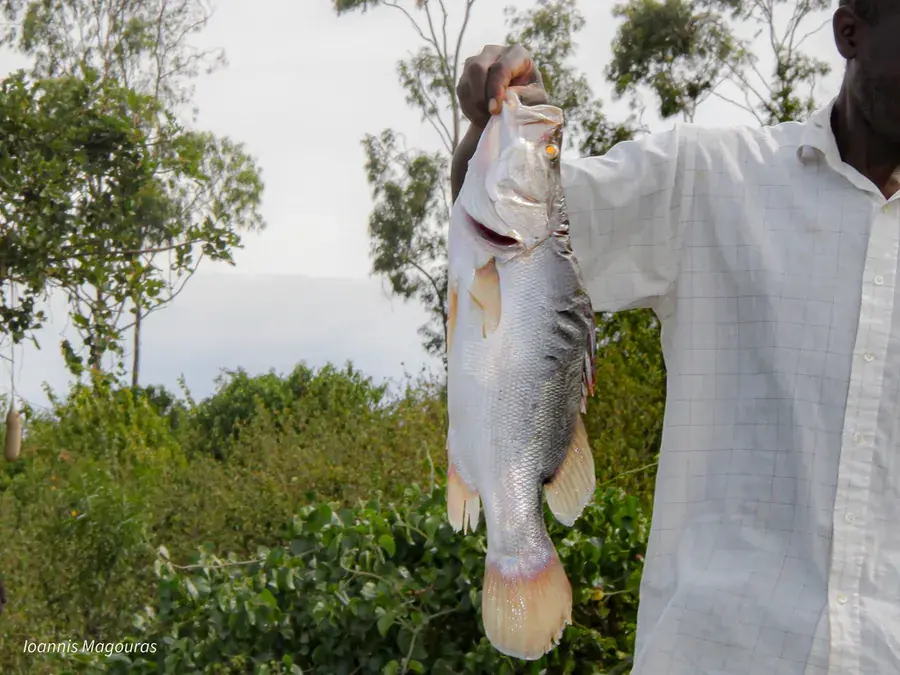
Nile perch
Lates niloticus
A huge silver perch with a blue sheen, a dorsal fin cut deeply into spiny and soft halves, a rounded tail, and a dark eye ringed in bright yellow.
Habitat and methods →Photo: Ioannis Magouras · CC BY 4.0
 FishYear-round
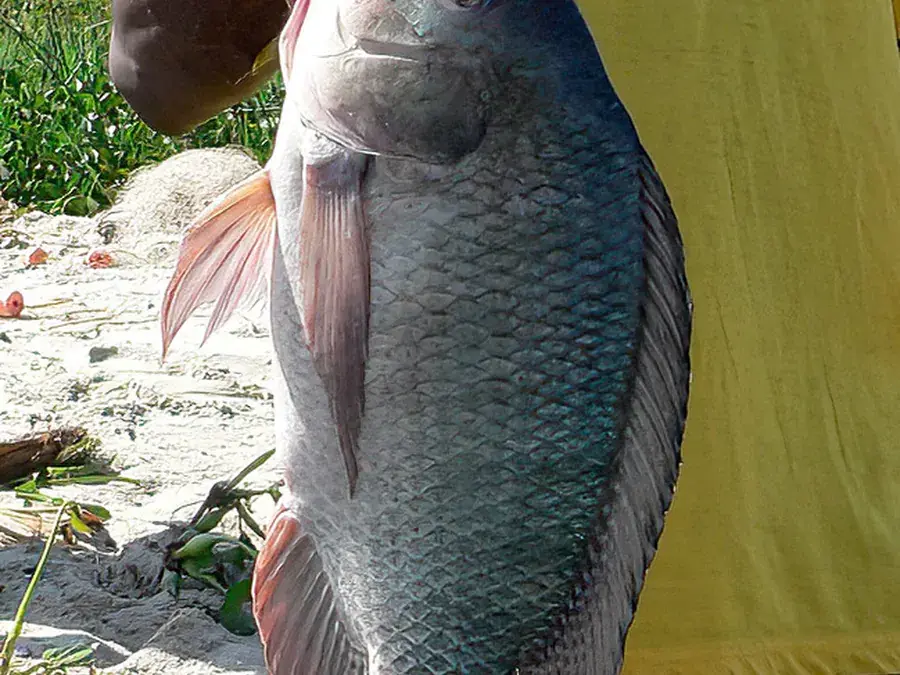
Nile tilapia
Oreochromis niloticus
Deep-bodied and grey-brown with faint bars, and the tell: regular dark vertical stripes right across the tail fin. Breeding males turn reddish, especially on the fins.
Habitat and methods →Photo: Pål A. Olsvik · CC BY 4.0
 FishSep–Apr
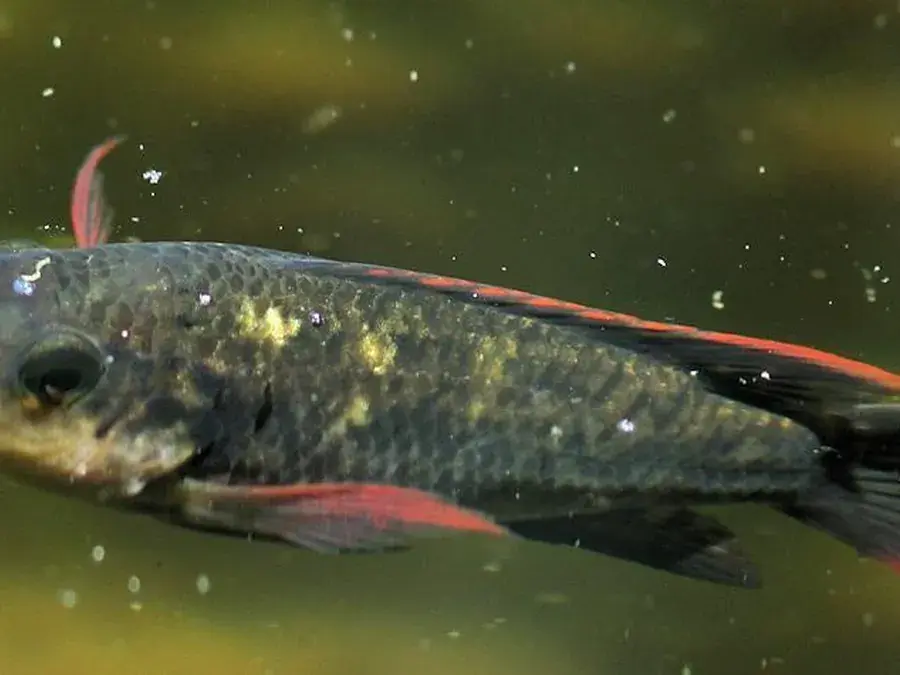
Mozambique tilapia (blue kurper)
Oreochromis mossambicus
Deep-bodied and dull silvery-olive with a few dark blotches along the side and no regular stripes on the tail. Breeding males turn black with a white throat, red-edged fins and a pointed, duck-bill snout.
Habitat and methods →Photo: Wynand Uys · CC BY 4.0