
Milkfish
Chanos chanos
- When
- Active all year; habitat and behaviour shift with the season.
- Habitat
- Clear lagoons, sand flats, channels and mangrove creeks along the East African coast and around Madagascar, the Seychelles and Mauritius, south to southern Mozambique and KwaZulu-Natal. Shoals cruise and feed on the flats on the rising tide; young fish live in estuaries.
- Identification
- A long, streamlined, silvery fish with a small, toothless mouth, a single, sail-like dorsal fin in the middle of the back, long sickle-shaped pectoral fins and a big, deeply forked tail. Olive green on the back; the fins have dark edges.
- Notes
- A grazer of algae and tiny animals that grows to well over a metre and runs like a tuna when hooked. Fly anglers stalk it on the flats of the Seychelles atolls with small algae flies; elsewhere it is mostly a net and pond fish, and one of the most important farmed fish in South-East Asia, where it is bangus or bandeng.
- Method
- A small algae fly, or a strand of green weed or bread on a small hook, put right in front of feeding fish in calm, clear water, on a long, light leader with plenty of backing.
- Caution
- No fishing in Kenya’s marine national parks — Malindi, Watamu, Mombasa and Kisite. In South Africa ten a day within the overall daily limit of ten fish, on a DFFE recreational permit (online or at the Post Office).
Seasons, size limits and catch limits change every year and differ by water body. Check the current regulations for the country and the water before fishing.
Milkfish facts
- Also called
- Bangus in the Philippines, bandeng or bolu in Indonesia, awa in Hawaii.
- Family
- Chanidae — the only living member of its family.
- Native range
- The tropical and subtropical Indo-Pacific, from South Africa and the Red Sea to Hawaii and the Marquesas, north to Japan and south to Victoria, Australia; and the eastern Pacific from San Pedro, California, to the Galápagos.
- Habitat
- Offshore water and shallow coastal bays around continents and islands where the sea is warmer than about 20°C; schools gather where reefs are well developed. It often enters estuaries, and occasionally fresh water.
- Water temperature
- Tropical. AquaMaps puts its preferred surface water at about 21–29°C (70–84°F); FishBase records it in water of 15–43°C in ponds and lagoons.
- Size
- Most adults 60–100 cm (24–39 in); the largest measured about 180 cm (71 in).
- Record
- IGFA all-tackle world record: 19.73 kg (43 lb 7 oz), Javier Vairo Puig, Bocana el Cordonsillo, Costa del Sol, El Salvador, 1 February 2012.
- Lifespan
- Up to about 15 years (FishBase).
- What it eats
- Cyanobacteria, soft algae and small bottom invertebrates, and even the eggs and larvae of other fish; the larvae eat zooplankton.
- Spawning
- At night, in clear, shallow water over sand or coral no more than about 30 km from shore, and only in full-strength sea water. A female sheds up to 5 million eggs, which hatch in about a day; the larvae drift for two to three weeks before heading inshore. Wild fish take three to five years to mature.
- Young fish
- Older larvae settle in mangroves, estuaries and coastal lagoons, and juveniles return to the sea to mature. Wild fry gathered along shores and river mouths have stocked fish ponds in South-East Asia for centuries.
- Teeth and mouth
- Small and toothless.
- Look-alikes
- Bonefish and ladyfish are also silver and fork-tailed, but the bonefish has a pointed snout with the mouth underneath and the ladyfish a large, toothed mouth. Mullets have two separate dorsal fins; the milkfish has one.
- Eating
- Excellent but very bony, with many fine bones in the flesh; deboned ‘boneless bangus’ is sold across the Philippines. One of the most important farmed fish in South-East Asia, sold fresh, smoked, canned and frozen.
- Status
- Least Concern on the IUCN Red List (2016).
Interactive
Milkfish: size range
Move the slider from a typical adult to the largest recorded specimen, shown against objects of known size.
Most adults you'll catch: 60–100 cm (24–39 in).
This milkfish: 80 cm. Longer than a loaf of bread, shorter than a four-year-old.
The record
IGFA all-tackle world record: 19.73 kg (43 lb 7 oz), Javier Vairo Puig, Bocana el Cordonsillo, Costa del Sol, El Salvador, 1 February 2012.
Questions people ask about milkfish
Can you catch milkfish on a rod?
Yes, but it takes patience: milkfish graze on algae and seldom take ordinary baits or lures. Fly anglers on the Seychelles atolls catch them with small algae flies cast to feeding fish, and once hooked they make long, fast runs.
Why is milkfish so bony?
Its flesh is laced with fine intermuscular bones. In the Philippines and Indonesia, where it is a staple farmed fish, much of it is sold deboned or pressure-cooked until the bones soften.
Where do milkfish live in Africa?
Along the East African coast from the Red Sea to South Africa, and around Madagascar, the Seychelles and Mauritius — over sand flats, in lagoons and in the mangrove estuaries where the young grow up.
Found in these regions
Checked against these sources ·
Sizes, records and ranges are for the species as a whole; local populations and rules vary. Records change; the record-keeper named above holds the current one.
Local activity
This week's guide for a place
Enter a town, postal code or ZIP for this week's conditions there, based on the local climate, this week's weather and the ecological region.
Also active in October
 FishYear-round
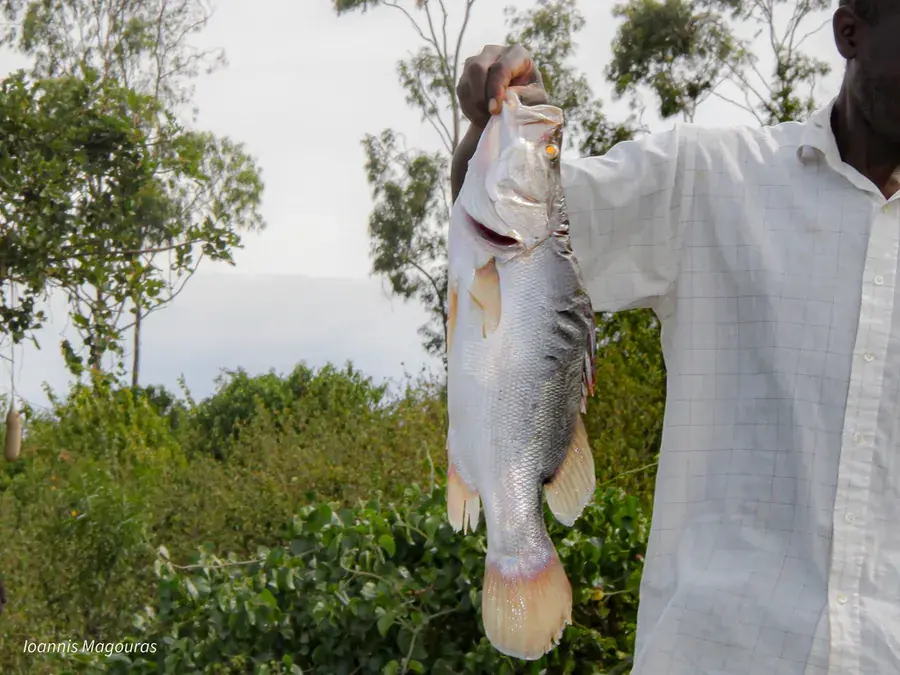
Nile perch
Lates niloticus
A huge silver perch with a blue sheen, a dorsal fin cut deeply into spiny and soft halves, a rounded tail, and a dark eye ringed in bright yellow.
Habitat and methods →Photo: Ioannis Magouras · CC BY 4.0
 FishYear-round
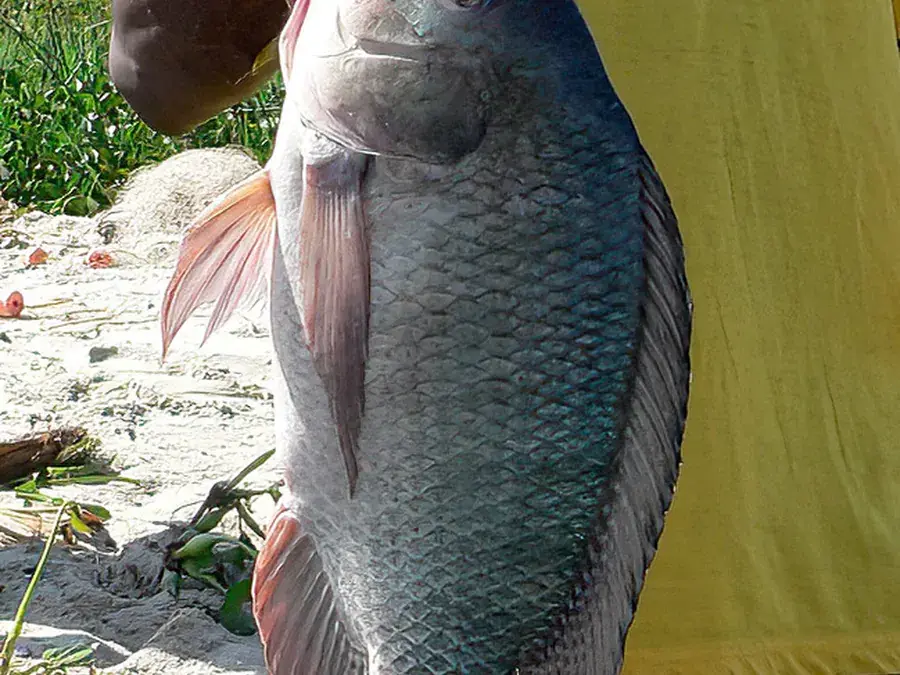
Nile tilapia
Oreochromis niloticus
Deep-bodied and grey-brown with faint bars, and the tell: regular dark vertical stripes right across the tail fin. Breeding males turn reddish, especially on the fins.
Habitat and methods →Photo: Pål A. Olsvik · CC BY 4.0
 FishSep–Apr
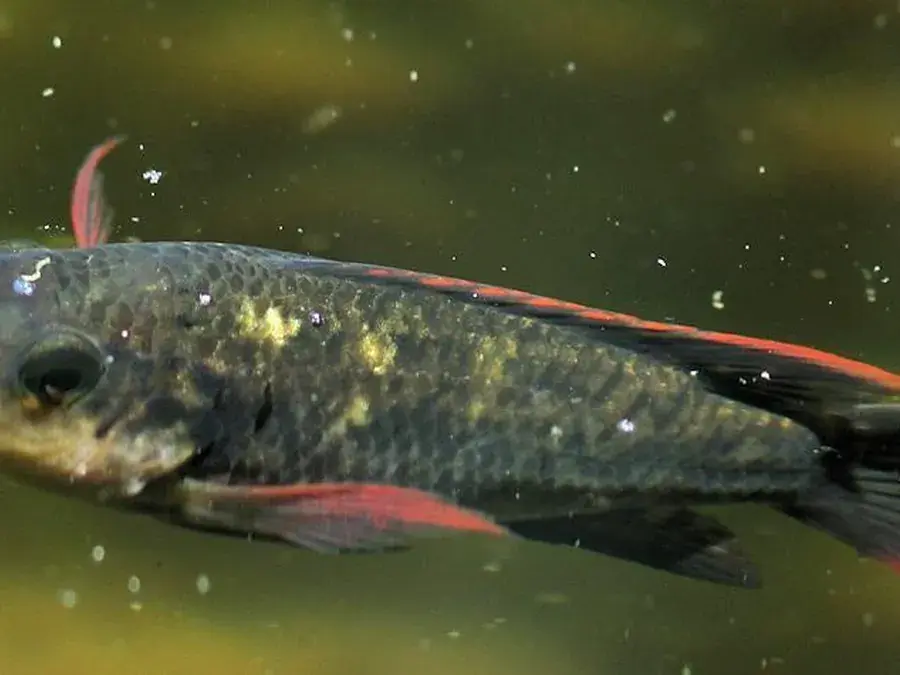
Mozambique tilapia (blue kurper)
Oreochromis mossambicus
Deep-bodied and dull silvery-olive with a few dark blotches along the side and no regular stripes on the tail. Breeding males turn black with a white throat, red-edged fins and a pointed, duck-bill snout.
Habitat and methods →Photo: Wynand Uys · CC BY 4.0