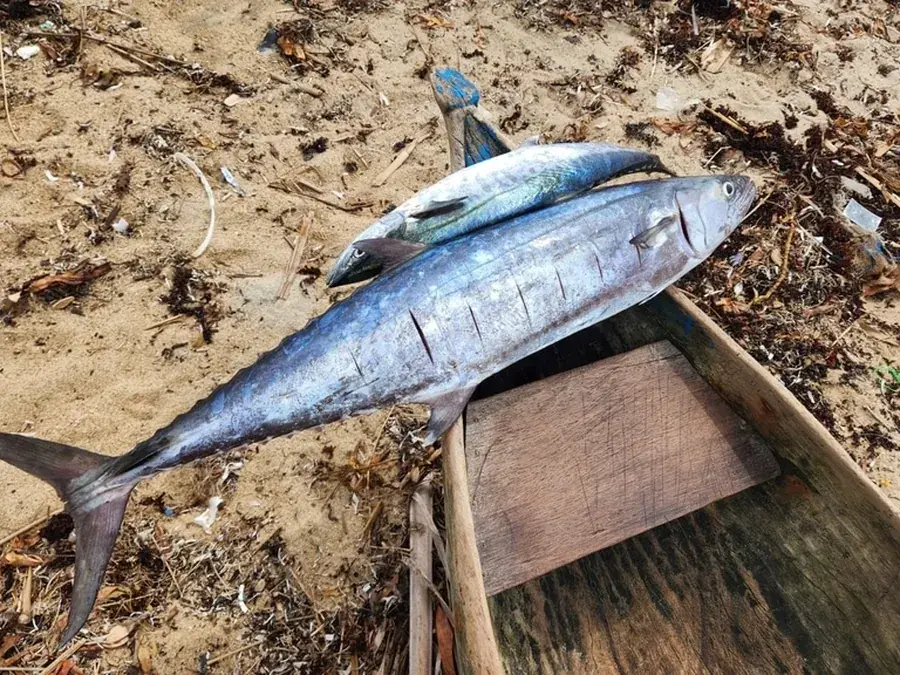
Photo by Rob Foster on iNaturalist · CC BY 4.0
Couta (narrow-barred Spanish mackerel)
Scomberomorus commerson
- When
- Active all year; habitat and behaviour shift with the season.
- Habitat
- Pinnacles, reef edges and the shelf off KwaZulu-Natal and Mozambique, and the reefs and channels of the Red Sea and East African coast — trolled from ski-boats and launches; seldom taken from the shore.
- Identification
- A long, blue-grey and silver mackerel covered in many thin, wavy vertical bars, with rows of finlets before the tail and a lateral line that drops sharply below the end of the second dorsal fin.
- Notes
- The king mackerel, couta or katonkel of South Africa and the kingfish of East Africa. Shoals move south from Mozambique into KwaZulu-Natal waters in summer, roughly November to March, to feed; on the tropical coast it is caught all year.
- Method
- A live or dead bait — a mackerel or a garfish — slow-trolled on a wire trace over reef pinnacles at first light.
- Caution
- In South Africa ten a day, no size limit, on a DFFE recreational permit (online or at the Post Office). Ciguatera poisoning has been reported from this species — ask locally before eating fish from tropical reefs.
Seasons, size limits and catch limits change every year and differ by water body. Check the current regulations for the country and the water before fishing.
Couta (narrow-barred Spanish mackerel) facts
- Also called
- King mackerel, couta, ’cuda or katonkel in South Africa; kingfish in East Africa; Spaniard in Australia. Not the king mackerel (Scomberomorus cavalla) of the western Atlantic.
- Family
- Scombridae, the tunas and mackerels.
- Native range
- The Indo-West Pacific, from South Africa and the Red Sea along the coasts of East Africa and southern Asia to China, Japan, Australia and Fiji; also St Helena, and a migrant through the Suez Canal into the eastern Mediterranean. In South Africa common in KwaZulu-Natal, rarely as far south as Mossel Bay.
- Habitat
- Open water from the edge of the continental shelf to shallow coastal water, drop-offs and reef slopes, often in murky, low-salinity water.
- Water temperature
- Tropical. AquaMaps puts its preferred surface water at about 22–29°C (72–84°F).
- Size
- Most adults 80–130 cm (31–51 in); the largest measured about 240 cm (94 in).
- Record
- IGFA all-tackle world record: 44.91 kg (99 lb), Michael Wilkinson, Scottburgh, KwaZulu-Natal, South Africa, 14 March 1982. The South African angling record is 46.4 kg (102 lb), from 1995.
- Lifespan
- Up to 14 years in South African waters and about 22 years elsewhere.
- What it eats
- Shoaling fish — anchovies, sardines, jacks and small mackerels — with squid and prawns.
- Spawning
- In spring and summer, roughly September to March, mainly off Mozambique, and further south into KwaZulu-Natal in good years. Females mature at about one and a half years.
- Young fish
- Juveniles are often spotted and live inshore and in estuaries and large bays.
- Teeth and mouth
- A long jaw reaching to the back of the eye, with strong, flattened, knife-like teeth.
- Look-alikes
- Queen mackerel (Scomberomorus plurilineatus) has broken lines along the sides and a lateral line that curves down gently. Wahoo has a snout as long as the rest of its head and a longer first dorsal fin, with 23–27 spines against the couta’s 15–18.
- Eating
- An important food fish, marketed mainly fresh, and also dried, salted, smoked and canned. Line-caught South African fish are WWF-SASSI orange (think twice); Mozambique’s are red (don’t buy).
- Status
- Near Threatened on the IUCN Red List (2022). The KwaZulu-Natal and southern Mozambique stock was assessed in 2013 as optimally exploited in South Africa but over-exploited in Mozambique.
Interactive
Couta: size range
Move the slider from a typical adult to the largest recorded specimen, shown against objects of known size.
Most adults you'll catch: 80–130 cm (31–51 in).
This couta (narrow-barred spanish mackerel): 105 cm. About as long as a four-year-old.
The record
IGFA all-tackle world record: 44.91 kg (99 lb), Michael Wilkinson, Scottburgh, KwaZulu-Natal, South Africa, 14 March 1982. The South African angling record is 46.4 kg (102 lb), from 1995.
Questions people ask about couta
Is a couta the same as a king mackerel?
In South Africa, yes — couta and king mackerel are both names for Scomberomorus commerson. It is not the king mackerel of Florida and the Gulf of Mexico, which is a different species, Scomberomorus cavalla.
When do couta come to KwaZulu-Natal?
In summer, roughly November to March, when shoals move south from Mozambique to feed. Strong years may be linked to above-average rainfall in Mozambique.
What is the bag limit for king mackerel in South Africa?
Ten a day, with no size limit and no closed season, on a DFFE recreational permit. Scientists have recommended cutting the limit to five.
Found in these regions
Checked against these sources ·
- FishBase — Scomberomorus commerson
- Mann (ed.), Southern African Marine Linefish Species Profiles — ORI Special Publication 9 (2013)
- WWF-SASSI — King mackerel
- Wikipedia — Narrow-barred Spanish mackerel
- IGFA — World Records search
Sizes, records and ranges are for the species as a whole; local populations and rules vary. Records change; the record-keeper named above holds the current one.
Local activity
This week's guide for a place
Enter a town, postal code or ZIP for this week's conditions there, based on the local climate, this week's weather and the ecological region.
Also active in October
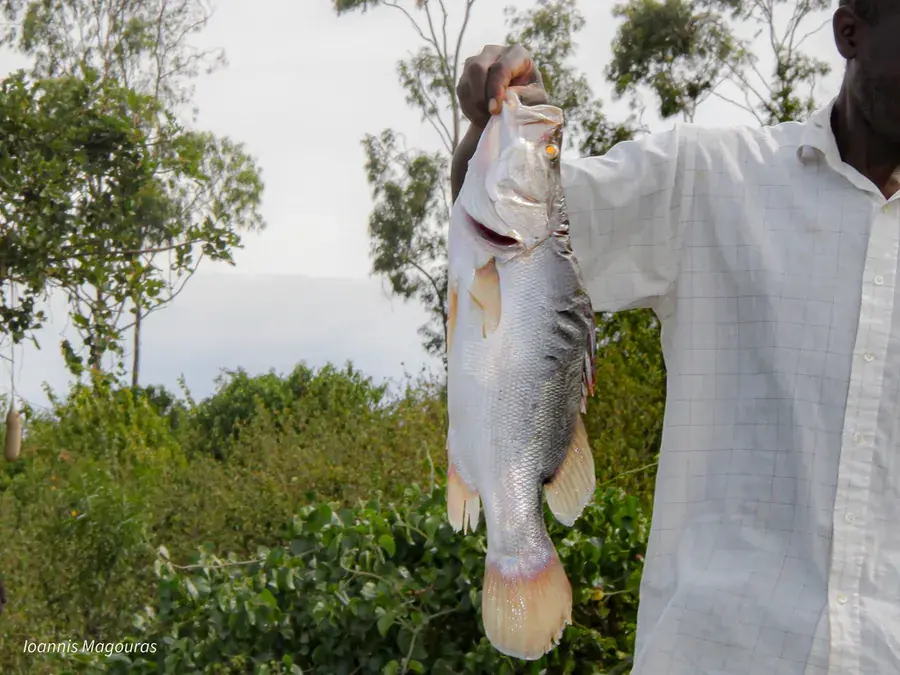 FishYear-round
Nile perch
Lates niloticus
A huge silver perch with a blue sheen, a dorsal fin cut deeply into spiny and soft halves, a rounded tail, and a dark eye ringed in bright yellow.
Habitat and methods →Photo: Ioannis Magouras · CC BY 4.0
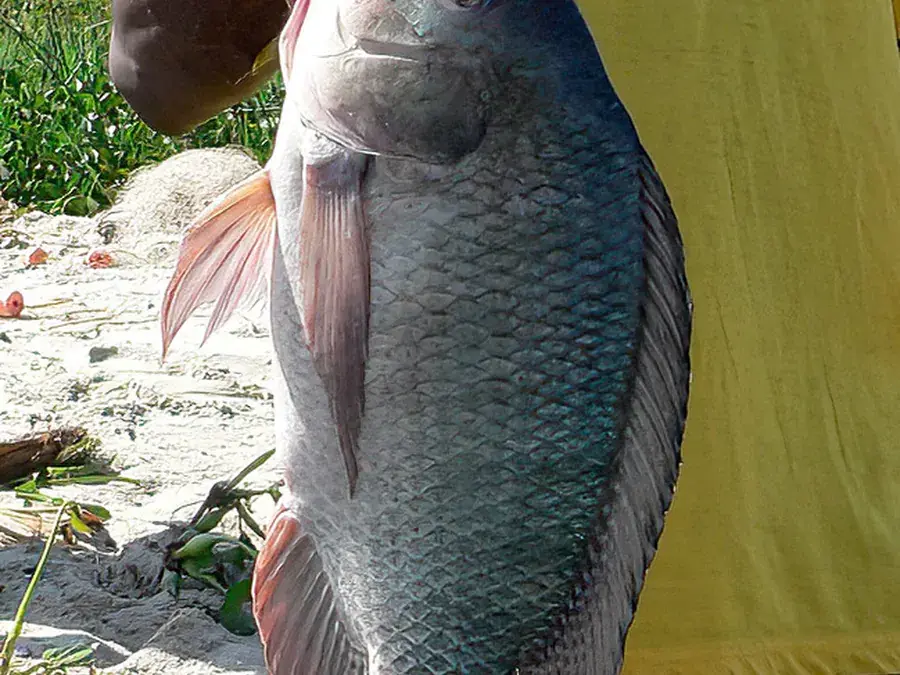 FishYear-round
Nile tilapia
Oreochromis niloticus
Deep-bodied and grey-brown with faint bars, and the tell: regular dark vertical stripes right across the tail fin. Breeding males turn reddish, especially on the fins.
Habitat and methods →Photo: Pål A. Olsvik · CC BY 4.0
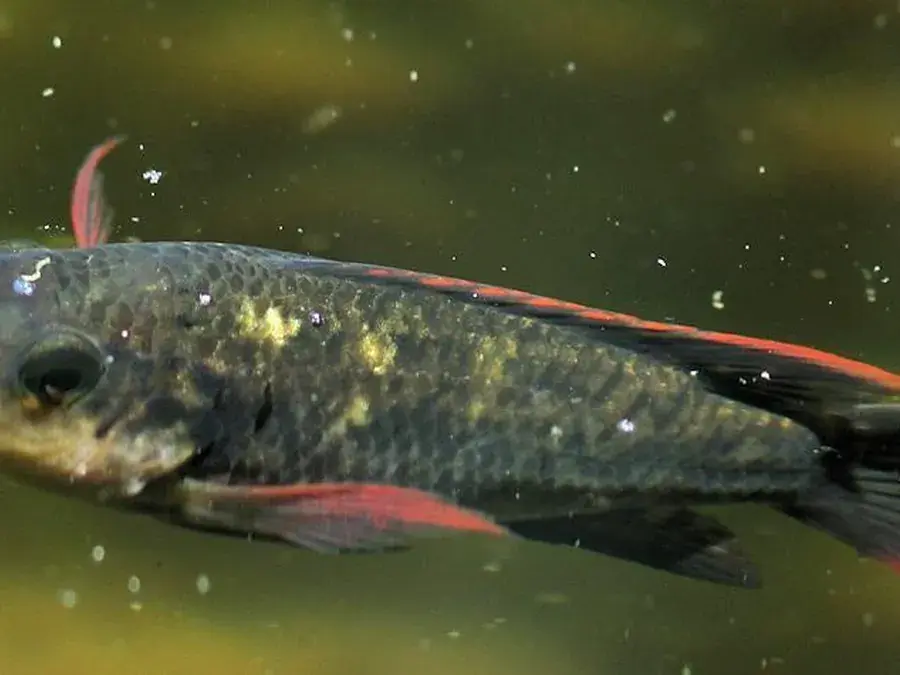 FishSep–Apr
Mozambique tilapia (blue kurper)
Oreochromis mossambicus
Deep-bodied and dull silvery-olive with a few dark blotches along the side and no regular stripes on the tail. Breeding males turn black with a white throat, red-edged fins and a pointed, duck-bill snout.
Habitat and methods →Photo: Wynand Uys · CC BY 4.0