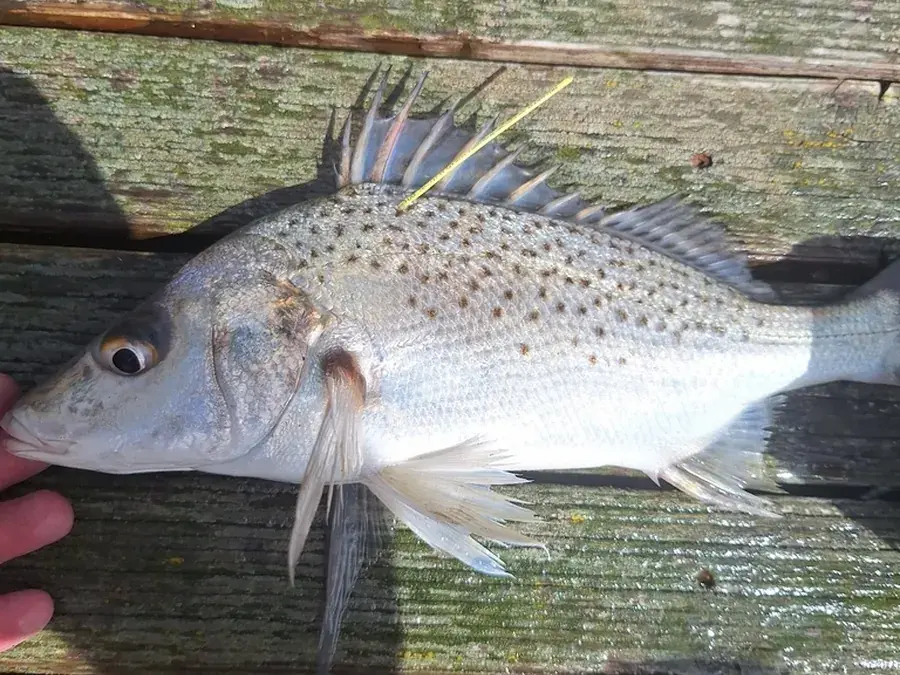
Photo by Andreas De Beer on iNaturalist · CC BY 4.0
Spotted grunter
Pomadasys commersonnii
- When
- Mar–Oct — March, April, May, June, July, August, September, October. Earlier where the water warms first.
- Habitat
- Sand- and mudbanks of estuaries on a rising tide — the Breede, Knysna, Kromme, Swartkops, Kowie and Great Fish estuaries in the Cape, Durban harbour, St Lucia and Kosi Bay in KwaZulu-Natal — and the estuaries and sheltered bays of Mozambique and East Africa.
- Identification
- Dark grey above, silver-white below, with many small brown spots over the back, sides and dorsal fin but not the head, a dark spot on the edge of the gill cover, and a small mouth with thick lips. Young fish have no spots.
- Notes
- One of South Africa’s most important estuary angling fish. It feeds over the banks by jetting water into the mud to blow prawns, worms and small clams out of their burrows. In the Cape it is scarce in winter and returns as the water warms in spring; most fish stay in one estuary for life.
- Method
- Live mud or sand prawn on a light running trace over the banks on the push of the tide; a small prawn fly cast to feeding fish in the shallows.
- Caution
- In South Africa five a day at 40 cm or more, on a DFFE recreational permit (online or at the Post Office), and it may not be sold. Listed as Vulnerable in South Africa’s 2018 National Biodiversity Assessment — WWF-SASSI asks anglers to release them. Spearfishing is not allowed in South African estuaries.
Seasons, size limits and catch limits change every year and differ by water body. Check the current regulations for the country and the water before fishing.
Spotted grunter facts
- Also called
- Spotty, tiger, knorhaan, spikkel knorder or inkolokolo in South Africa; smallspotted grunter.
- Family
- Haemulidae, the grunts.
- Native range
- The western Indian Ocean: from the Gulf of Aden down the East African coast to Cape Point and the south-western Cape, Madagascar and the Seychelles, and along the Asian coast from Yemen and the Persian Gulf to north-west India.
- Habitat
- Estuaries and shallow coastal water over soft sand and mud, down to about 50 m (160 ft). It tolerates fresh water and adults sometimes move up to the river–estuary boundary.
- Water temperature
- Warm-temperate to tropical. AquaMaps puts its preferred surface water at about 18–28°C (64–82°F).
- Size
- Most adults 35–60 cm (14–24 in); the largest measured about 91 cm (36 in).
- Record
- IGFA all-tackle world record: 2.92 kg (6 lb 7 oz), Riyaz Hussain, Durban, South Africa, 6 October 2024. The South African angling record is far heavier: 9.5 kg (21 lb), from Durban in 1949.
- Lifespan
- About 15 years, and up to 19 in KwaZulu-Natal.
- What it eats
- Burrowing animals — sand and mud prawns, pencil bait and other bivalves, worms and amphipods — which it blows out of the mud with a jet of water.
- Spawning
- At sea near estuary mouths and in harbours, in KwaZulu-Natal from about August to December; ripe fish have also been found in the Breede estuary in summer. Males mature at about two and a half years, females at three.
- Young fish
- Young fish settle in estuaries, which serve as nurseries, and have no spots at first.
- Teeth and mouth
- Small, with moderately thick lips, and two pores and a central pit on the chin.
- Look-alikes
- Javelin grunter (Pomadasys kaakan) of KwaZulu-Natal and Mozambique is golden-green above as an adult, and its young show faint vertical bars of small spots rather than a scatter of spots. White steenbras feeds the same way but is plain silver.
- Eating
- Good eating, but a no-sale species in South Africa and WWF-SASSI asks anglers to release it.
- Status
- Least Concern on the IUCN Red List (2018), but listed as Vulnerable in South Africa’s 2018 National Biodiversity Assessment; KwaZulu-Natal’s stock was rated overexploited.
Interactive
Spotted grunter: size range
Move the slider from a typical adult to the largest recorded specimen, shown against objects of known size.
Most adults you'll catch: 35–60 cm (14–24 in).
This spotted grunter: 48 cm. Longer than a loaf of bread, shorter than a four-year-old.
The record
IGFA all-tackle world record: 2.92 kg (6 lb 7 oz), Riyaz Hussain, Durban, South Africa, 6 October 2024. The South African angling record is far heavier: 9.5 kg (21 lb), from Durban in 1949.
Questions people ask about spotted grunter
What is the bag limit for spotted grunter?
Five a day at 40 cm or more, on a DFFE recreational permit. It may not be sold, and spearfishing is banned in all South African estuaries.
Where is the best spotted grunter fishing?
In the estuaries of the Eastern Cape and KwaZulu-Natal — the Kromme, Swartkops, Kowie and Great Fish, Durban harbour, St Lucia and Kosi Bay — and in the Western Cape the Breede and the Garden Route estuaries, best from spring to autumn.
Do spotted grunter leave their estuary?
Rarely. Tagging shows that 95% are recaptured within 3.5 km of where they were tagged. They go to sea to spawn and can be flushed out by floods and storms, but most live in one estuary.
Found in these regions
Checked against these sources ·
- FishBase — Pomadasys commersonnii
- Mann (ed.), Southern African Marine Linefish Species Profiles — ORI Special Publication 9 (2013)
- WWF-SASSI — Spotted grunter
- Wikipedia — Pomadasys commersonnii
- IGFA — World Records search
- FOSAF — Saltwater fly-fishing report, Garden Route
Sizes, records and ranges are for the species as a whole; local populations and rules vary. Records change; the record-keeper named above holds the current one.
Local activity
This week's guide for a place
Enter a town, postal code or ZIP for this week's conditions there, based on the local climate, this week's weather and the ecological region.
Also active in October
 FishYear-round
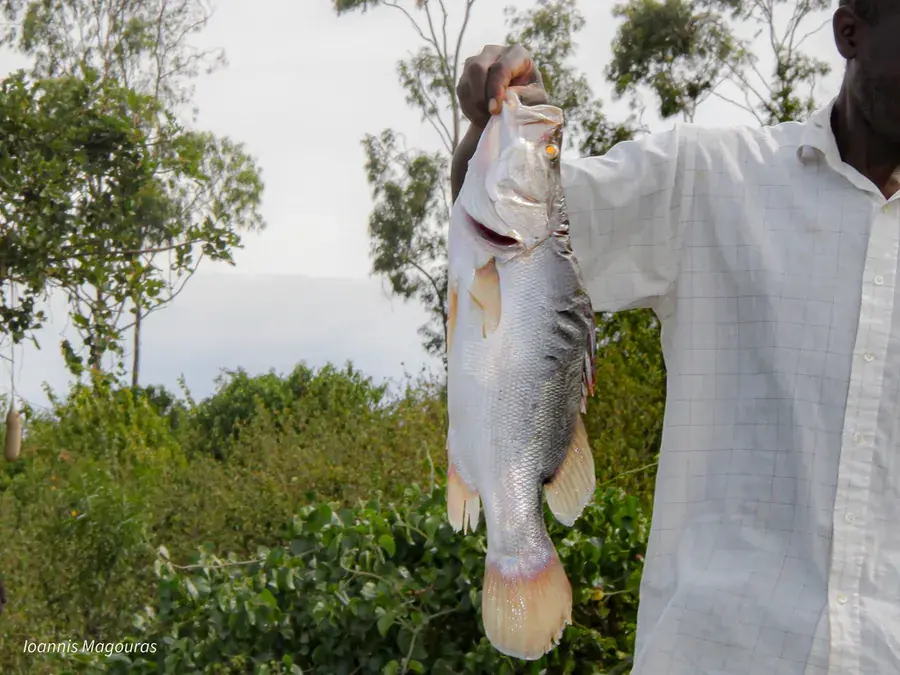
Nile perch
Lates niloticus
A huge silver perch with a blue sheen, a dorsal fin cut deeply into spiny and soft halves, a rounded tail, and a dark eye ringed in bright yellow.
Habitat and methods →Photo: Ioannis Magouras · CC BY 4.0
 FishYear-round
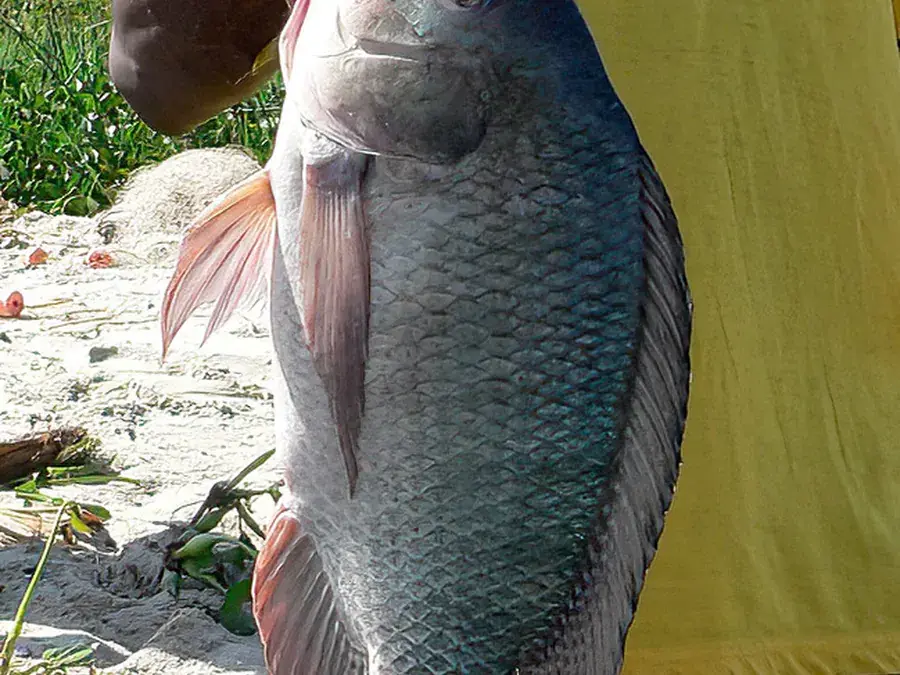
Nile tilapia
Oreochromis niloticus
Deep-bodied and grey-brown with faint bars, and the tell: regular dark vertical stripes right across the tail fin. Breeding males turn reddish, especially on the fins.
Habitat and methods →Photo: Pål A. Olsvik · CC BY 4.0
 FishSep–Apr
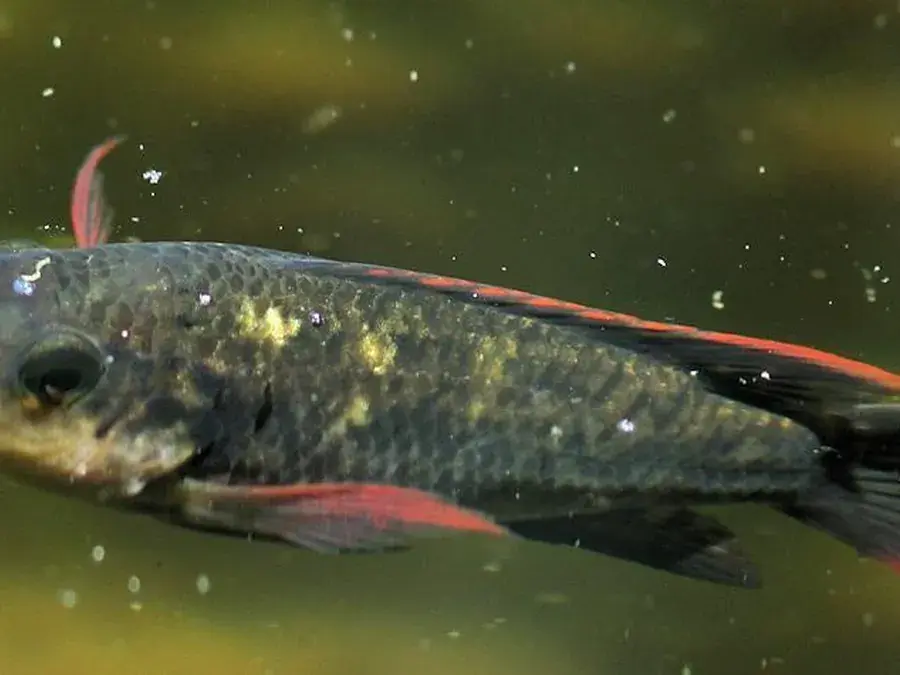
Mozambique tilapia (blue kurper)
Oreochromis mossambicus
Deep-bodied and dull silvery-olive with a few dark blotches along the side and no regular stripes on the tail. Breeding males turn black with a white throat, red-edged fins and a pointed, duck-bill snout.
Habitat and methods →Photo: Wynand Uys · CC BY 4.0