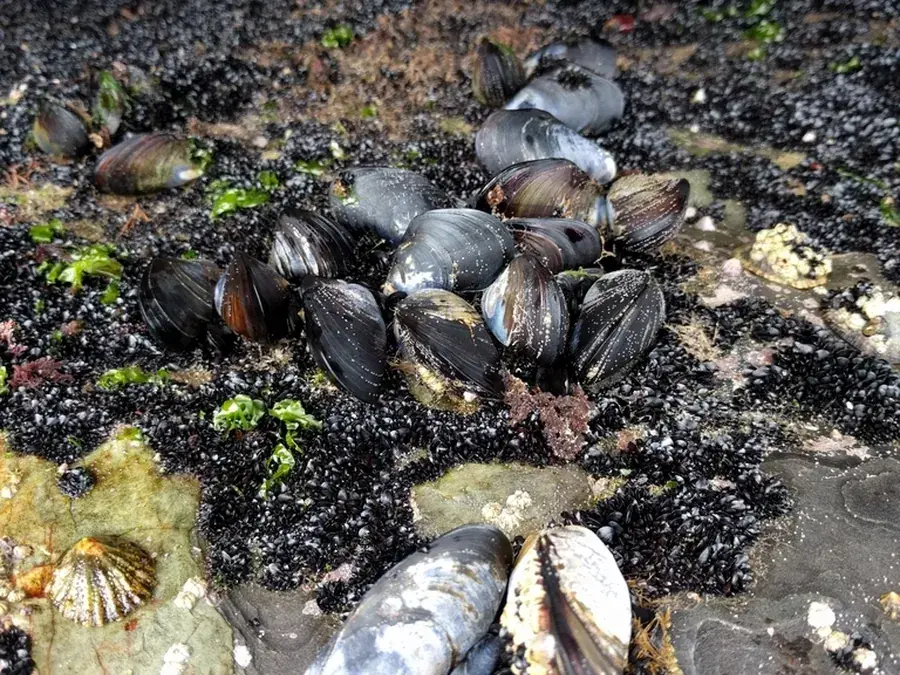
Photo by Tom on iNaturalist · CC BY-SA 4.0 · photographed specimen identified as Mytilus galloprovincialis, a close relative
Coastal·In season (October)
Mussels (rock mussels)
Mytilus spp., Choromytilus meridionalis, Perna perna
- When
- Typically September – April — September, October, November, December, January, February, March, April. Earlier in warm, low country; later in the hills.
- Where it grows
- Dense beds on wave-washed rocks, piers and harbour walls from the middle shore down into the shallows, reached on low spring tides. In South Africa, the black mussel and the introduced Mediterranean mussel cover the West and South coasts and the brown mussel the South and East coasts; in Europe, the blue and Mediterranean mussels; in North America, the blue mussel on the Atlantic and its Pacific relatives in the west.
- Identification
- Paired, wedge-shaped shells, pointed at the hinge end and rounded at the other, anchored in clusters by tough threads (the byssus, or beard). Blue and Mediterranean mussels are blue-black, purple or brownish and grow to about 14 cm (5½ in); the Cape's black mussel is narrower, glossier and blacker; the brown mussel is brown.
- Look-alikes
- No dangerous look-alike: the danger in a mussel is what it has filtered from the water. In South Africa, 'white mussels' are a different animal — clams dug from sandy beaches — under their own limits and the same red-tide warnings.
- Harvest and use
- Gather at low tide on clean, open coast, by hand or with a blunt blade (in South Africa, no wider than 12 mm). Keep only live, unbroken mussels, scrub them and pull off the beard, then steam them open in a covered pot for a few minutes. Throw away any that are cracked or smell bad, and eat them the same day.
- Caution
- Paralytic shellfish poisoning (red tide) can kill. Cooking and freezing do not destroy it, and the water may look clear. Before every trip, check the warnings: South Africa's DFFE issues red-tide alerts, and then no shellfish from that coast is safe; Namibia's government issues its own; Britain and the EU classify and close harvesting areas; Norway publishes Mattilsynet's mussel warning; Canada's DFO lists closures; California's annual quarantine runs from 1 May to 31 October; Alaska tests only commercial shellfish. South Africa requires a recreational permit and sets a daily bag limit (check current limits), and bans collecting between sunset and sunrise. Never pick near harbours, marinas or outfalls, after heavy rain, or from washed-up shellfish.
Mussels (rock mussels) at a glance
- Also called
- Black mussel (Choromytilus meridionalis), Mediterranean mussel (Mytilus galloprovincialis), brown mussel (Perna perna) and blue mussel (Mytilus edulis, with M. trossulus in the North Pacific); together 'rock mussels' in South African regulations
- Family
- Mytilidae (the sea mussels)
- Where it grows
- South Africa: the black mussel from central Namibia to Gqeberha; the Mediterranean mussel, introduced and now the dominant low-shore mussel, from the Namibian border to Port Alfred; the brown mussel on the South and East coasts. Europe: the blue mussel from France's Atlantic coast north to Iceland, and the Mediterranean mussel in the Mediterranean and Black Sea and up the Atlantic to Britain. North America: the blue mussel on the Atlantic coast and the Pacific blue mussel in the north-west.
- When to pick
- In the north, the old rule of eating wild mussels only in months with an R (September to April) keeps clear of the spring and summer, when toxic blooms are most likely — but blooms now come at other times too. In South Africa red tides occur most often in summer. Whatever the month, check the official warnings first.
- Parts used
- The whole cooked animal inside the shell. Remove the beard.
- Is any of it poisonous?
- Mussels themselves are wholesome; the danger is what they filter from the water. Paralytic shellfish toxins, made by algae such as Alexandrium, cause tingling of the lips and tongue within minutes to hours, then numbness, dizziness, loss of balance, slurred speech and difficulty swallowing and breathing, and can kill. Diarrhetic toxins cause sickness and diarrhoea, and domoic acid confusion, seizures and memory loss. None is destroyed by cooking or freezing, and none changes the taste.
Questions people ask about mussels
Does cooking make red-tide mussels safe?
No. The algal toxins behind paralytic shellfish poisoning are heat-stable: cooking and freezing do not destroy them, and they don't change the taste. The only protection is not eating shellfish from an affected area.
How do I know if mussels are safe to pick in South Africa?
Check for red-tide warnings from the Department of Forestry, Fisheries and the Environment (DFFE) before you go. When it issues one, all shellfish from that coast — from the shore, from deeper water or washed up — must not be eaten. Some blooms are colourless, so clear water proves nothing.
Do I need a permit to pick mussels in South Africa?
Yes. The Marine Living Resources Act regulations forbid collecting any shellfish without a permit; recreational permits are sold at post offices. There is a daily bag limit for rock mussels (check current limits), they may be taken only by hand or with a blade no wider than 12 mm, no shellfish may be collected between sunset and sunrise, and marine protected areas have their own rules.
What are the symptoms of paralytic shellfish poisoning?
Tingling or burning of the lips, tongue and fingertips, starting within minutes to a few hours of eating, then numbness, dizziness, loss of balance, slurred speech and trouble swallowing. Severe cases bring paralysis and breathing failure: get emergency help at once.
Where else are mussels monitored?
Almost everywhere, but not always for foragers. In Britain the Food Standards Agency classifies harvesting areas, and France allows recreational gathering only in class A or B areas; Norway publishes Mattilsynet's mussel warning; Canada's DFO posts closures; California quarantines sport-harvested mussels from 1 May to 31 October; in Massachusetts the state classifies the beds and the town shellfish constable knows the current closures. Alaska tests only commercial shellfish, so its beaches are not monitored for pickers. Namibia's government monitors shellfish and issues warnings when toxins rise.
Found in these regions
Local season
This week's foraging guide for a place
Enter a town, postal code or ZIP for what is in season there this week, based on the local climate, this week's weather and the ecological region.
Also in season in October
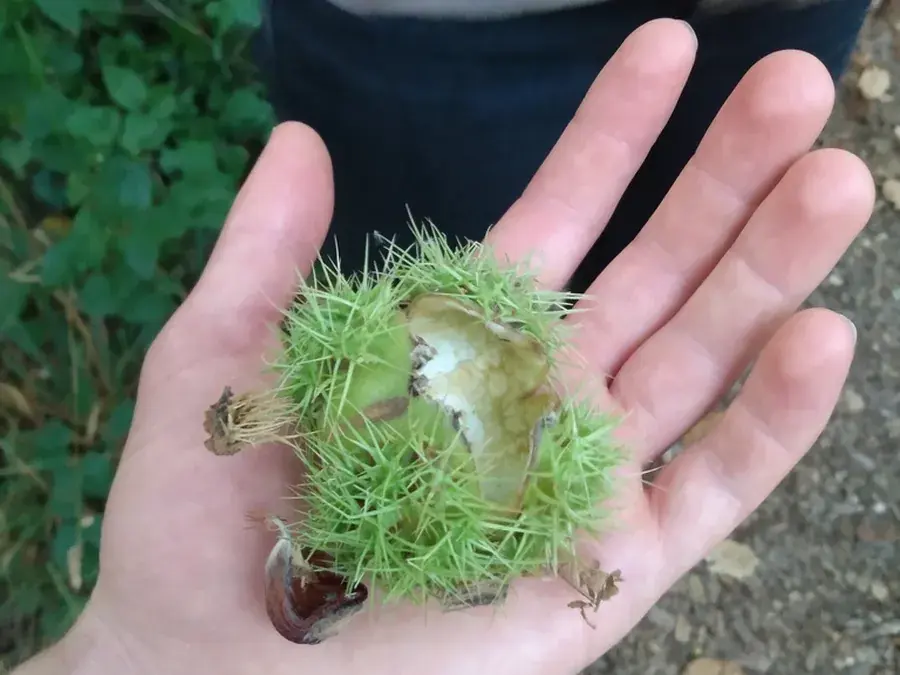 NutOctober – November
Sweet chestnut
Castanea sativa
A big tree with long, glossy leaves edged with sharp, regular teeth, and bark that twists in spiralling ridges on old trunks. The nuts come in twos and threes inside a husk covered in dense, needle-sharp spines; each is glossy brown, flat on one side, with a pointed tuft at the tip.
Identification and look-alikes →Photo: John Powers · CC BY 4.0
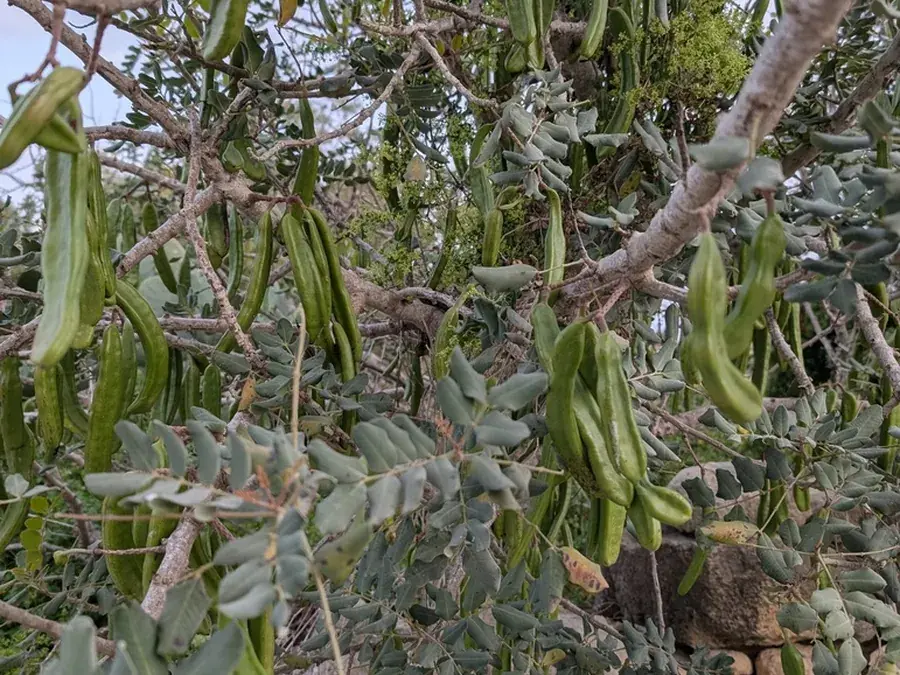 FruitAugust – October
Carob (St John's bread)
Ceratonia siliqua
A broad, round-crowned evergreen tree up to 15 m (50 ft) with leaves 10–20 cm (4–8 in) long, divided into pairs of leaflets. Small flowers grow straight from the trunk and old branches in autumn. The pods are flat, leathery and slightly curved, 10–30 cm (4–12 in) long, ripening from green to dark brown, sweet-smelling, with 10–13 very hard seeds. Most trees are male or female, and only females bear pods.
Identification and look-alikes →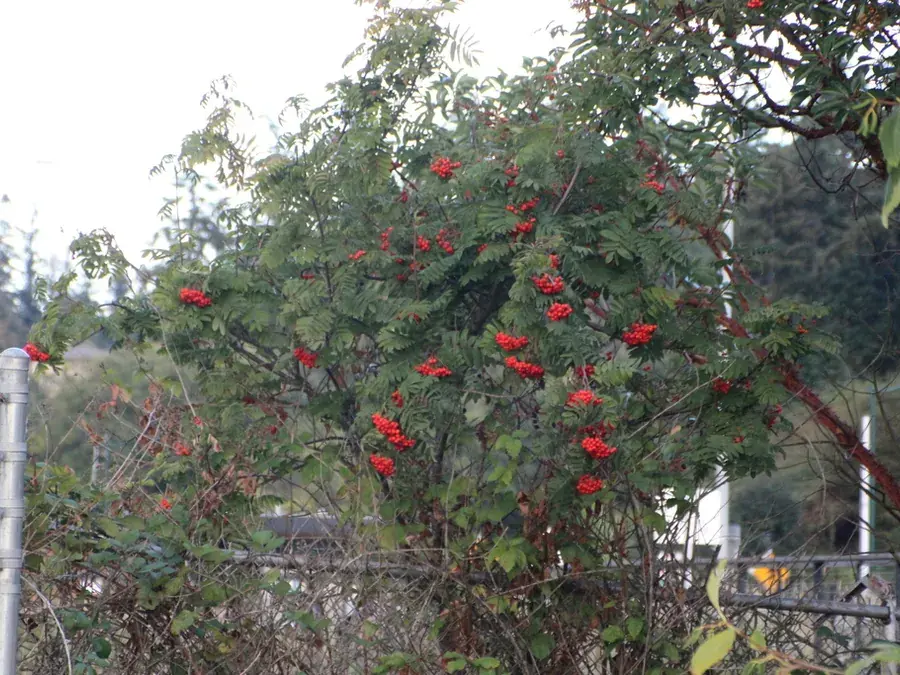 BerryAugust – October
Rowan berries
Sorbus aucuparia
A slim tree with smooth silvery-grey bark and feathery leaves of many toothed leaflets in pairs; big flat clusters of scarlet-orange berries, each about 1 cm (⅜ in) across with a tiny black five-pointed star at the tip.
Identification and look-alikes →Photo: Therese Phillips · CC BY 4.0
Checked against these sources ·
- SAnews (DFFE) — Public warned not to harvest or eat wild shellfish from Saldanha Bay (May 2026)
- SAnews (DFFE) — Public warned against consuming dead shellfish (January 2026)
- Cape Argus — DFFE warns public against consuming shellfish amid ongoing red tide concerns (January 2026)
- EWN — Red tide returns to SA's West Coast: what it is and why seafood warnings matter
- Marine Living Resources Act regulations, reg. 55 — Shellfish, red bait and other invertebrate fish
- Marine Living Resources Act regulations, reg. 56 — Size limits, gear restrictions and fishing methods
- Oceanographic Research Institute — Recreational linefishing regulations (permits from the Post Office)
- Wikipedia — Choromytilus meridionalis
- Wikipedia — Mytilus galloprovincialis
- Wikipedia — Perna perna
- Wikipedia — Blue mussel
- Food Standards Agency (GOV.UK) — Shellfish classification
- The Highland Council — Biotoxins affecting bivalve shellfish in Loch Eishort ('cooking does not remove risks')
- ARS Nouvelle-Aquitaine — Pêche à pied récréative
- Norwegian Institute of Public Health (FHI) — Skjellforgiftning (shellfish poisoning)
- Fisheries and Oceans Canada — Harvest shellfish safely
- County of San Diego — Sport-harvested mussels quarantine
- San Luis Obispo County — Annual quarantine of sport-harvested mussels ends October 31
- Mass.gov — Shellfish classification areas
- AGU — Alaska Native tribes take lead on shellfish toxin testing where state falls short
- The Namibian — Mussels
Seasons are typical for the middle of the range and move by weeks north and south, and up and down hills.
Educational information only. Never eat a wild plant or mushroom identified from a single photograph or description — confirm with a regional field guide or an experienced forager, and know the poisonous species in your area first.