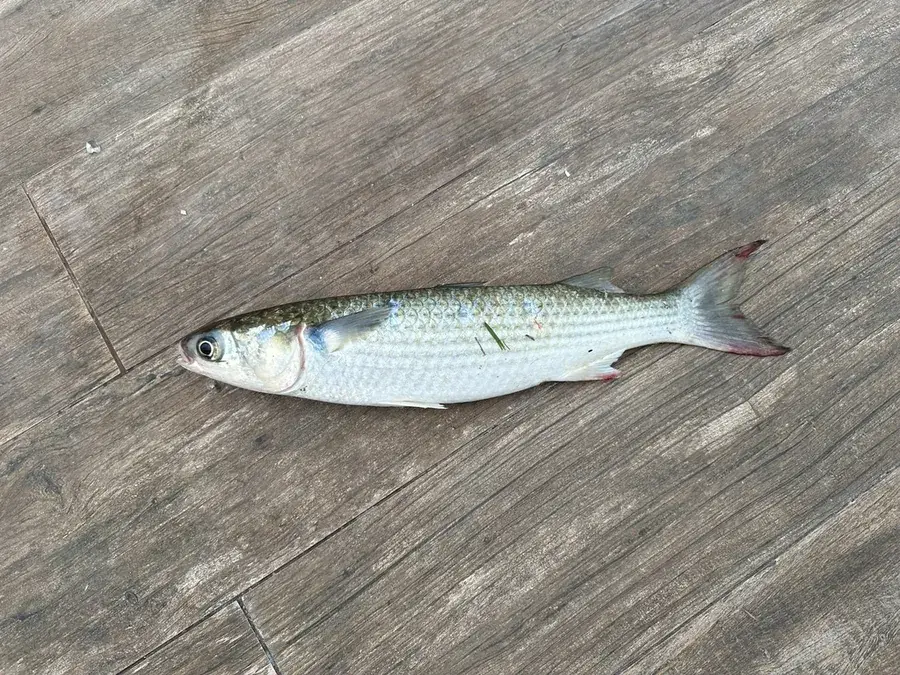
Flathead grey mullet (striped mullet)
Mugil cephalus
- When
- Active all year; habitat and behaviour shift with the season.
- Habitat
- Harbours, marinas, estuaries, lagoons and river mouths almost anywhere warm — shoals cruise quays and the lower reaches of rivers, and often run far upstream into fresh water.
- Identification
- A stout, round-bodied fish with a broad, flat head, a thin upper lip and a clear, fatty eyelid that covers most of the eye. Olive-green above, silver on the sides, often with six or seven dark stripes along the flank; it has no visible lateral line.
- Notes
- Found in coastal water in every warm and temperate sea. A grazer of algae, detritus and tiny animals, so it ignores most lures: bread and dough are the classic baits. Shoals move to sea to spawn, and young fish depend on estuaries.
- Method
- Bread flake or dough on a small hook under a light float, after loose-feeding bread in a harbour or estuary to get the shoal feeding.
- Caution
- In South Africa mullet carry a 50-a-day limit with no size limit; an angling permit covers rod and line only, so netting them for bait needs separate authorisation — check with DFFE first. Elsewhere minimum sizes vary (30 cm on France’s Atlantic and Channel coasts).
Seasons, size limits and catch limits change every year and differ by water body. Check the current regulations for the local jurisdiction and the water before fishing.
Flathead grey mullet (striped mullet) facts
- Also called
- Striped mullet (its IGFA name), grey mullet, black mullet, sea mullet and common mullet; flathead mullet in South Africa.
- Family
- Mugilidae, the mullets.
- Native range
- Coastal waters of tropical, subtropical and temperate seas worldwide: the Atlantic from Nova Scotia to Brazil and from the Bay of Biscay to South Africa, including the Mediterranean and Black Sea; the Indian Ocean from South Africa to India; the Pacific from Japan to Australia and from California to Chile. Genetic work suggests it is a complex of closely related species.
- Habitat
- Coastal water, estuaries, lagoons, mangroves and rivers, sometimes far upstream, from the surface to about 10 m; schools over sand and mud. It moves freely between fresh, brackish and salt water.
- Water temperature
- Wide-ranging. AquaMaps puts its preferred surface water, across tropical and temperate coasts, at about 16–28°C (61–82°F); FishBase gives 8–24°C (46–75°F).
- Size
- Most adults 30–50 cm (12–20 in); the largest measured about 100 cm (39 in).
- Record
- IGFA all-tackle world record (as striped mullet): 4.71 kg (10 lb 6 oz), Scott Lindner, Upper Laguna Madre, Texas, USA, 13 March 2009.
- Lifespan
- Up to about 16 years.
- What it eats
- Microscopic algae, detritus and small bottom animals, grazed by day; larvae eat zooplankton.
- Spawning
- At sea, in schools that move offshore, at different times of year in different places — in South Africa between May and November, often near estuary mouths. Females shed 0.8–2.6 million eggs; fish mature at three to four years.
- Young fish
- Larvae drift back inshore, and juveniles depend on estuaries as nurseries.
- Teeth and mouth
- Small, with a thin upper lip and fine teeth; a fatty (adipose) eyelid covers most of the eye.
- Look-alikes
- Other grey mullets — the thick-lipped, thin-lipped and golden grey mullets of Europe and the harder (Chelon richardsonii) of the Cape — look much alike. The flathead grey mullet’s tells are its broad, flat head, the fatty eyelid over most of the eye, and a thin upper lip without papillae.
- Eating
- An important food fish worldwide, fried, smoked or baked; its salted, pressed roe is bottarga in Italy, avgotaraho in Greece and karasumi in Japan.
- Status
- Least Concern on the IUCN Red List (2022).
Interactive
Flathead grey mullet: size range
Move the slider from a typical adult to the largest recorded specimen, shown against objects of known size.
Most adults you'll catch: 30–50 cm (12–20 in).
This flathead grey mullet (striped mullet): 40 cm. Longer than a loaf of bread, shorter than a four-year-old.
The record
IGFA all-tackle world record (as striped mullet): 4.71 kg (10 lb 6 oz), Scott Lindner, Upper Laguna Madre, Texas, USA, 13 March 2009.
Questions people ask about flathead grey mullet
How do you catch a mullet on a rod?
Usually with bread. Mullet graze on algae and detritus and seldom take lures; in estuaries and harbours, anglers loose-feed or groundbait with bread and fish a pinch of bread on a small hook under a light float.
Can mullet live in fresh water?
Yes. The flathead grey mullet moves freely between salt, brackish and fresh water, often running far up rivers, though it returns to the sea to spawn.
What is bottarga?
The salted, pressed and dried roe of the flathead grey mullet (and some other fish) — bottarga in Italy, avgotaraho in Greece and karasumi in Japan.
Found in these regions
- Northeast Atlantic Coast & Piedmont
- Southeastern Piedmont & Coastal Plain
- Gulf Coast & Mississippi Lowlands
- Florida Peninsula
- Mediterranean California
- Hawaiʻi & the Tropics
- Mediterranean Europe
- Pannonian Basin & Eastern Plains
- Mediterranean North Africa & Atlas
- Sahara, Nile & Horn
- Sahel & Sudanian Savanna
- West African Coast & Guinean Forest
- East African Coast
- Southern Savanna & Subtropical Coast
- Namib, Kalahari & Karoo
- Cape Fynbos & Winter-Rain Coast
- Madagascar & Indian Ocean Islands
Checked against these sources ·
- FishBase — Mugil cephalus
- Mann (ed.), Southern African Marine Linefish Species Profiles — ORI Special Publication 9 (2013)
- Wikipedia — Flathead grey mullet
- ORI — Marine recreational fishing regulations in South Africa
- Sea Angler — The kit you need to catch estuary mullet
- IGFA — World Records search
Sizes, records and ranges are for the species as a whole; local populations and rules vary. Records change; the record-keeper named above holds the current one.
Local activity
This week's guide for a place
Enter a town, postal code or ZIP for this week's conditions there, based on the local climate, this week's weather and the ecological region.
Also active in October
 FishYear-round
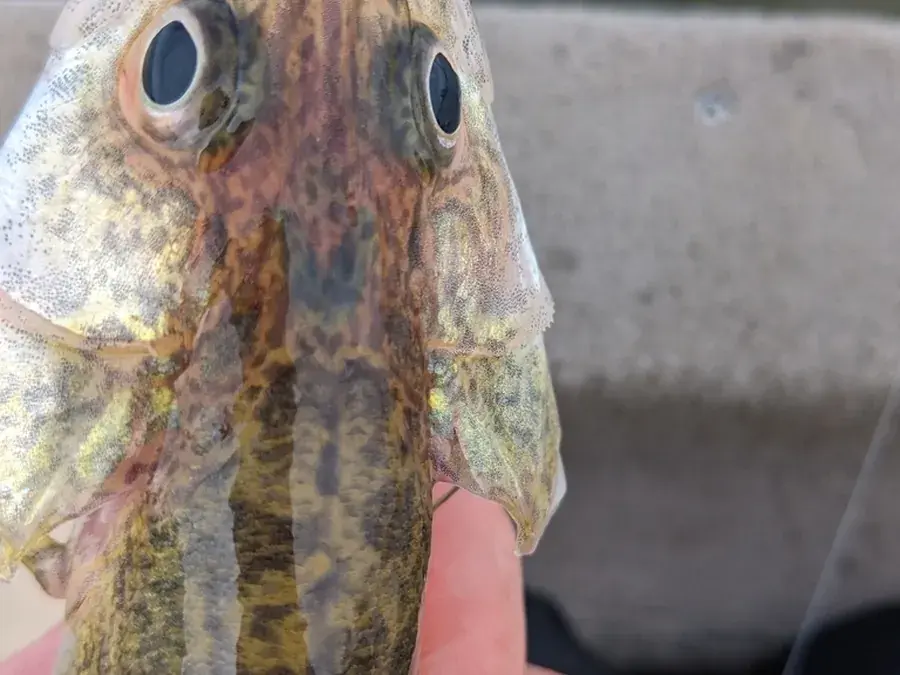
Walleye
Sander vitreus
Olive-gold flanks, a spiny first dorsal, and the big glassy eye that gives it the name and lets it hunt in low light.
Habitat and methods →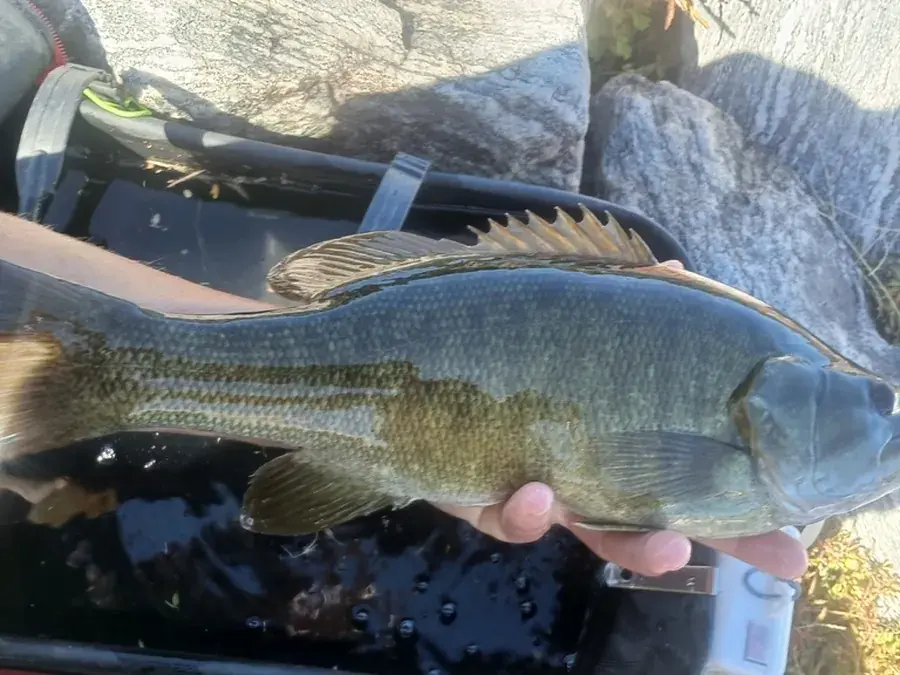 FishMay–Oct
Smallmouth bass
Micropterus dolomieu
Bronze-brown with vertical bars, red eye, and a jaw that ends level with the eye — not past it.
Habitat and methods →Photo: Joshua Johnson · CC BY 4.0
 FishApr–Oct
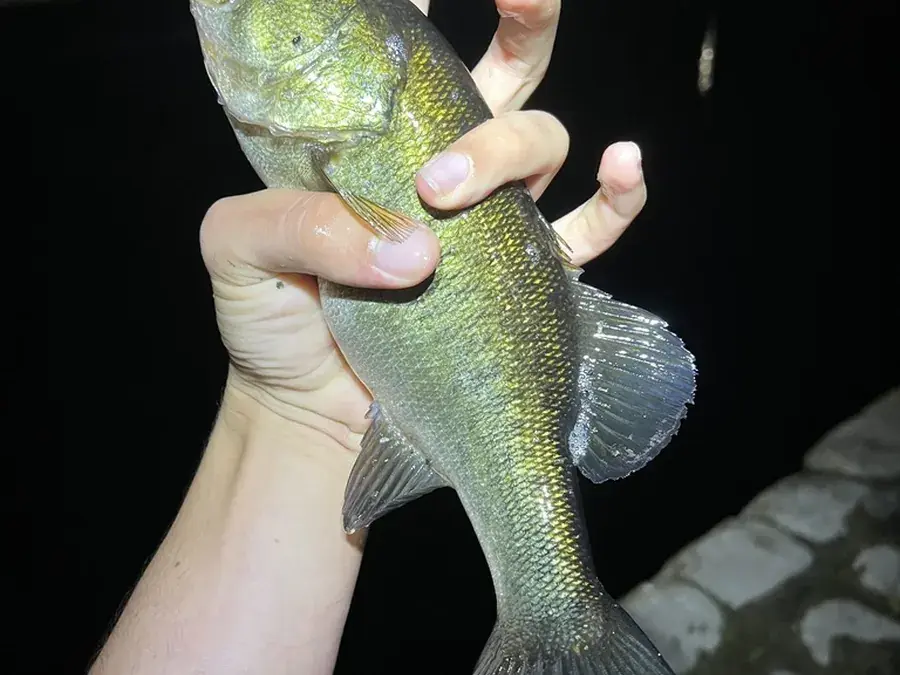
Largemouth bass
Micropterus nigricans
Green with a dark lateral stripe, and an upper jaw that extends past the back of the eye.
Habitat and methods →Photo: Nick Tobler (Cowturtle) · CC BY 4.0