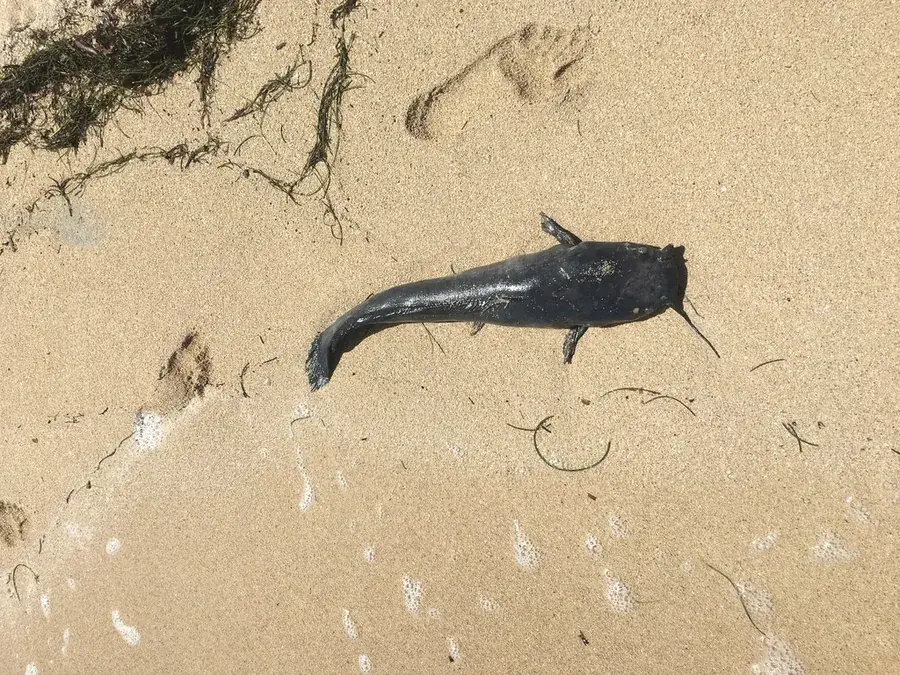
Photo by Lukas Zangl on iNaturalist · CC BY 4.0
Sharptooth catfish (barbel)
Clarias gariepinus
- When
- Mar–Oct — March, April, May, June, July, August, September, October. Earlier where the water warms first.
- Where it holds
- Almost any warm fresh water — big rivers, dams, swamps, floodplain pools, even canals. Shallow, muddy, weedy margins by night; it breathes air and can outlast a drying pool.
- How to know it
- A long, eel-like body, a flat bony head, four pairs of whiskers, and one very long dorsal fin with no small fatty fin behind it. Dark grey to olive above, white below.
- What to know
- South Africa’s ‘barbel’ and the most widespread catfish in Africa — its name comes from the Gariep, the Orange River. Hardy, nocturnal and strong; the record tops 40 kg.
- The tactic
- Liver, worms or a strip of fish on the bottom after dark, near a weed bed or where a stream comes in.
- Caution
- The pectoral spines puncture — grip firmly behind the head. Outside its native range, including the Western Cape, it is an invasive alien: never move live fish.
Seasons, size limits and catch limits change every year and differ by water body. Check the current regulations for the country and the water before you fish.
Sharptooth catfish (barbel) facts
- Also called
- Barbel in South Africa (baber in Afrikaans); African catfish, North African catfish. The species name comes from its type locality, the Gariep — the Khoekhoe name for the Orange River.
- Family
- Clariidae, the air-breathing catfishes.
- Native range
- Almost all of Africa except the Maghreb, the Upper Guinea coast, most of Cameroon-to-Gabon Lower Guinea and the Cape, plus the Middle East (Israel, Jordan, Lebanon, Syria and southern Turkey).
- Introduced to
- Spread worldwide for fish farming since the 1980s. In South Africa it has invaded Western and Eastern Cape rivers, partly through water-transfer schemes.
- Habitat
- Quiet water above all: vegetated edges of rivers and lakes, swamps, floodplain pools, canals and dams, usually over soft mud — though it turns up in rapids too. It breathes air with a special organ behind the gills and can cross land at night.
- Water temperature
- Tolerant: FishBase gives 8–35°C (46–95°F). It feeds and grows best in warm summer water.
- Size
- Most adults 50–100 cm (20–39 in); the largest measured about 170 cm (67 in).
- Record
- IGFA all-tackle world record: 42.18 kg (93 lb), Hennie Moller, Orange River at Kakamas, South Africa, 23 April 2003.
- Lifespan
- Up to about 15 years.
- What it eats
- Almost anything: insects, plankton, snails, crabs, shrimp, fish, frogs, young birds, carrion, fruit and seeds. It feeds mostly at night, and occasionally at the surface.
- Spawning
- In the rainy season, at night, on newly flooded plains and shallow margins. Pairs spawn after aggressive courtship and scatter the eggs widely; there is no parental care. Larvae swim within 2–3 days, and the young stay on the floodplain until they are 1.5–2.5 cm long.
- Teeth and mouth
- A broad, terminal mouth with bands of small, fine teeth and four pairs of barbels (whiskers). The real hazard is the pectoral-fin spines.
- Look-alikes
- Vundu has a large fatty (adipose) fin behind the dorsal fin and even longer whiskers; the sharptooth catfish has no adipose fin at all — just one long dorsal fin.
- Eating
- Good, and widely farmed — in much of Africa it sells for more than tilapia because it can be sold live. Hybrids with vundu (‘hetero-clarias’) are farmed for their white flesh.
- Status
- Least Concern on the IUCN Red List; a pest where it has been introduced.
Try it
How big does a sharptooth catfish get?
Slide it from an ordinary adult to the biggest one ever measured, next to things you know the size of.
Most adults you'll catch: 50–100 cm (20–39 in).
This sharptooth catfish (barbel): 75 cm. Longer than a loaf of bread, shorter than a four-year-old.
The record
IGFA all-tackle world record: 42.18 kg (93 lb), Hennie Moller, Orange River at Kakamas, South Africa, 23 April 2003.
Questions people ask about sharptooth catfish
Can catfish walk on land?
The sharptooth catfish can, after a fashion. It breathes air through an organ behind its gills and uses its strong pectoral spines to wriggle overland at night, from a drying pool to new water. It can also survive buried in mud between rainy seasons.
How big do African sharptooth catfish get?
Up to 1.7 m (5 ft 7 in) and about 60 kg (130 lb), though most anglers’ fish are under a metre. The IGFA all-tackle record is 42.18 kg (93 lb), from the Orange River at Kakamas, South Africa, in 2003.
Why is it called barbel in South Africa?
For its whiskers — barbels. South African anglers simply call the sharptooth catfish ‘barbel’ (baber in Afrikaans). It is not related to the European barbel, which is a carp.
How do you tell a sharptooth catfish from a vundu?
Look behind the dorsal fin. A vundu has a big fatty adipose fin almost as long as the dorsal; a sharptooth catfish has no adipose fin, just one very long dorsal fin running down its back.
Found in these regions
Checked against these sources ·
Sizes, records and ranges are for the species as a whole; local fish, and local rules, vary. Records change — the record-keeper named above has the current one.
Is it active near you?
Get this week's guide for your area
Enter a town, postal code or ZIP and we'll tell you what's happening right there this week — from your local climate, this week's weather and your ecological region.
Also active in October
 FishYear-round
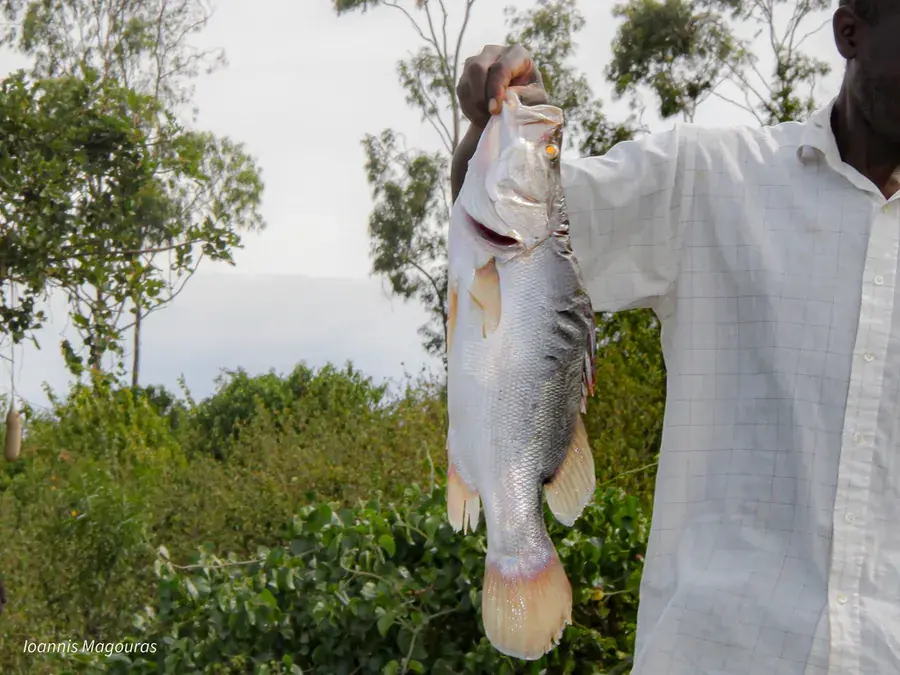
Nile perch
Lates niloticus
A huge silver perch with a blue sheen, a dorsal fin cut deeply into spiny and soft halves, a rounded tail, and a dark eye ringed in bright yellow.
Where and how to catch it →Photo: Ioannis Magouras · CC BY 4.0
 FishYear-round
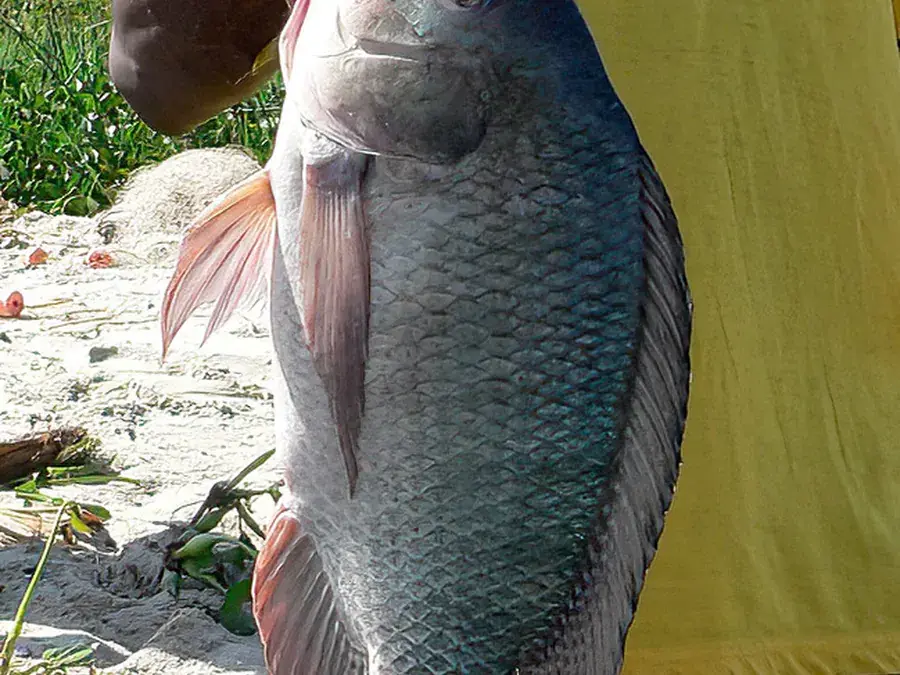
Nile tilapia
Oreochromis niloticus
Deep-bodied and grey-brown with faint bars, and the tell: regular dark vertical stripes right across the tail fin. Breeding males turn reddish, especially on the fins.
Where and how to catch it →Photo: Pål A. Olsvik · CC BY 4.0
 FishSep–Apr
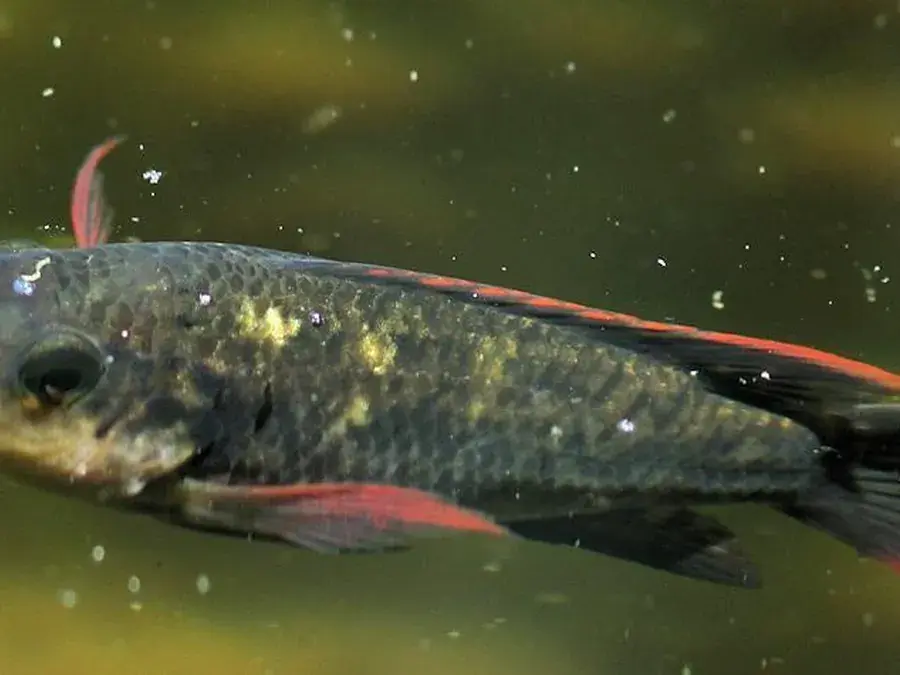
Mozambique tilapia (blue kurper)
Oreochromis mossambicus
Deep-bodied and dull silvery-olive with a few dark blotches along the side and no regular stripes on the tail. Breeding males turn black with a white throat, red-edged fins and a pointed, duck-bill snout.
Where and how to catch it →Photo: Wynand Uys · CC BY 4.0