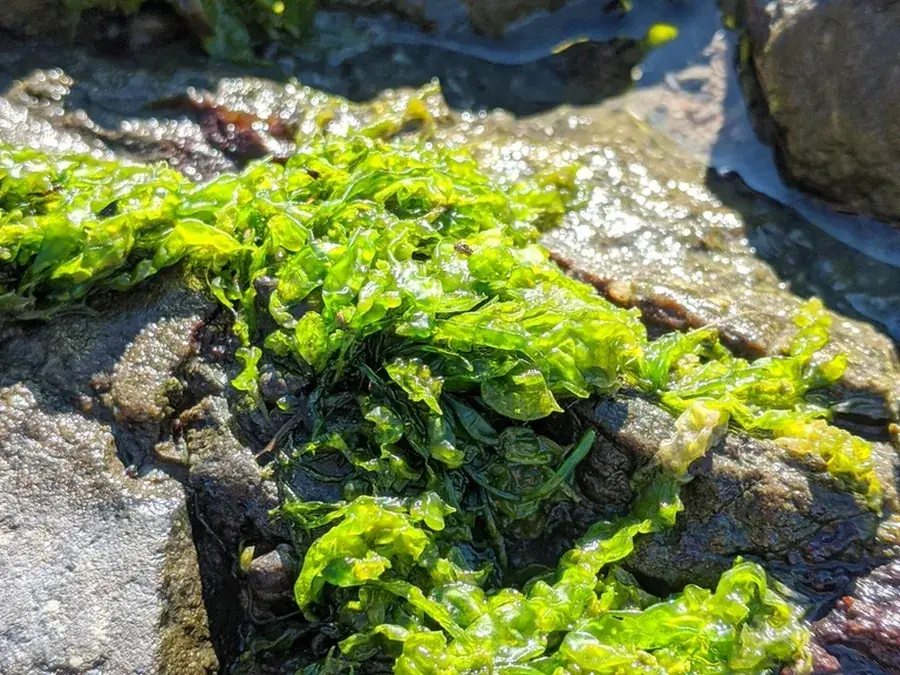
Photo by Benoit Renaud on iNaturalist · CC BY 4.0
Coastal·In season (October)
Sea lettuce
Ulva spp.
- When
- All year, though what is worth picking changes with the rains and the seasons.
- Where it grows
- On rocks, in pools and on other seaweeds at every level of the shore and into the shallows, in estuaries and harbours too. It grows most lushly where the water is rich in nutrients.
- Identification
- Bright to dark green, translucent, crumpled sheets up to about 30 cm (12 in) across and only two cells thick — like wet green tissue paper — fixed by a tiny disc, with no stalk.
- Look-alikes
- The risk is not a look-alike but the water: a thick, lush mat of sea lettuce is a sign of nutrient-rich, often polluted water, not of clean water.
- Harvest and use
- Cut fresh, attached, bright green sheets from clean water and rinse them well. Eat them raw in salads or simmer them in soups, as the Scots do. In Wales it goes into laverbread, and in Japan and Korea it is eaten with rice.
- Caution
- Take only attached, healthy sheets from clean, open coast — never from harbours, near outfalls or from drifts on the beach. Rotting heaps of green seaweed give off hydrogen sulphide, a toxic gas that caused deaths during the 2009 blooms in Brittany. In South Africa, collecting any seaweed needs a permit, and Namibia has its own rules; Washington State requires a licence; California sets a daily limit and closes marine protected areas; elsewhere, reserves and some states and provinces have their own rules. Cut with scissors and leave the base.
Sea lettuce at a glance
- Also called
- Green laver. Several closely related Ulva species are gathered under the name.
- Family
- Ulvaceae (green seaweeds)
- Where it grows
- Practically worldwide: Europe and the Mediterranean, both coasts of North America, and Africa, where in South Africa it is most often recorded on the Cape coast. It grows on all but the most exposed rocky shores and into estuaries.
- When to pick
- All year round. Choose young, bright green, firmly attached sheets.
- Parts used
- The whole frond, raw, cooked or dried.
Questions people ask about sea lettuce
Is sea lettuce edible?
Yes. It is eaten raw in salads and in soups in Scotland, sometimes mixed into Welsh laverbread, and served with rice in Japan and Korea. Rinse it well and take it only from clean water.
Where should I not pick sea lettuce?
Anywhere the water may be polluted: harbours, marinas, outfalls and estuaries below towns. Sea lettuce grows most prolifically where nutrients are abundant, so a thick mat is a warning sign. Never gather it from drifts on the beach.
Is rotting sea lettuce dangerous?
Yes. Heaps of decomposing green seaweed give off hydrogen sulphide, a toxic gas; during the 2009 blooms in Brittany it caused deaths. Keep away from thick, rotting drifts.
Do I need a permit to collect seaweed?
In South Africa, yes: the Marine Living Resources Act regulations forbid collecting any aquatic plant without one. Washington State requires a licence and allows 4.5 kg (10 lb) wet weight a day; California sets the same daily limit and closes marine protected areas. Elsewhere, check local rules.
Found in these regions
Local season
This week's foraging guide for a place
Enter a town, postal code or ZIP for what is in season there this week, based on the local climate, this week's weather and the ecological region.
Also in season in October
 NutOctober – November
Sweet chestnut
Castanea sativa
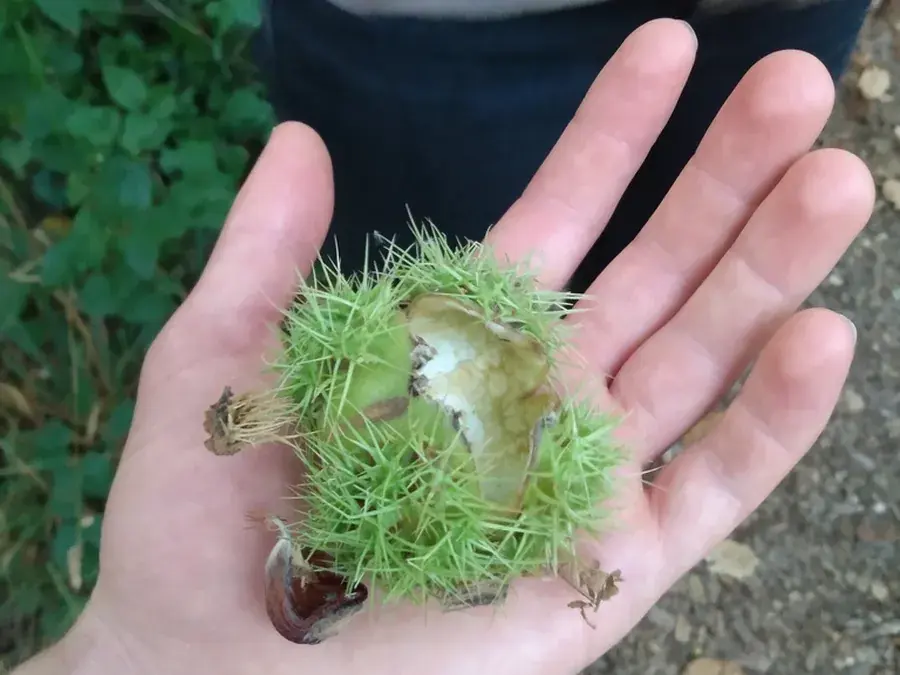
A big tree with long, glossy leaves edged with sharp, regular teeth, and bark that twists in spiralling ridges on old trunks. The nuts come in twos and threes inside a husk covered in dense, needle-sharp spines; each is glossy brown, flat on one side, with a pointed tuft at the tip.
Identification and look-alikes →Photo: John Powers · CC BY 4.0
 FruitAugust – October
Carob (St John's bread)
Ceratonia siliqua
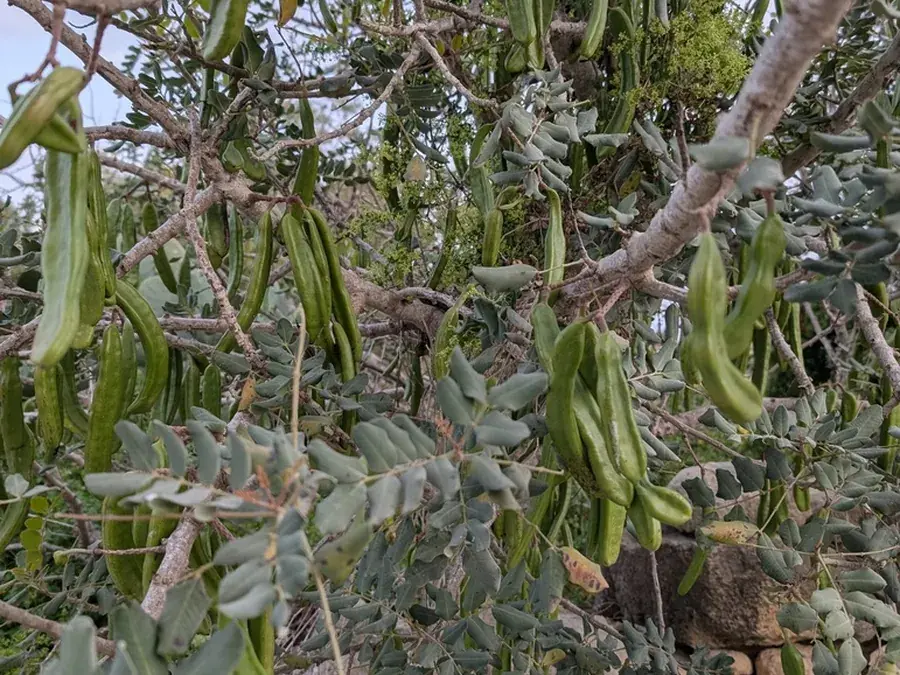
A broad, round-crowned evergreen tree up to 15 m (50 ft) with leaves 10–20 cm (4–8 in) long, divided into pairs of leaflets. Small flowers grow straight from the trunk and old branches in autumn. The pods are flat, leathery and slightly curved, 10–30 cm (4–12 in) long, ripening from green to dark brown, sweet-smelling, with 10–13 very hard seeds. Most trees are male or female, and only females bear pods.
Identification and look-alikes →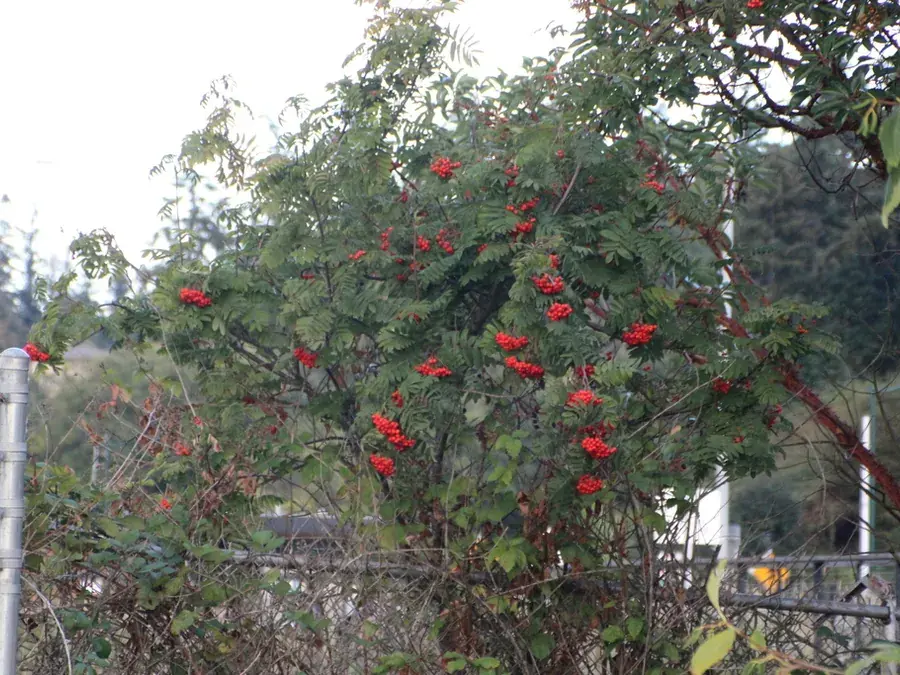 BerryAugust – October
Rowan berries
Sorbus aucuparia
A slim tree with smooth silvery-grey bark and feathery leaves of many toothed leaflets in pairs; big flat clusters of scarlet-orange berries, each about 1 cm (⅜ in) across with a tiny black five-pointed star at the tip.
Identification and look-alikes →Photo: Therese Phillips · CC BY 4.0
Checked against these sources ·
- Wikipedia — Ulva lactuca
- MarLIN (Marine Biological Association) — Sea lettuce
- Scottish Wildlife Trust, Living Seas — Sea lettuce
- Marine Living Resources Act regulations, reg. 57 — Aquatic plants
- Washington Department of Natural Resources — Seaweed
- California Department of Fish and Wildlife — Recreational harvest of kelp and other marine algae
Seasons are typical for the middle of the range and move by weeks north and south, and up and down hills.
Educational information only. Never eat a wild plant or mushroom identified from a single photograph or description — confirm with a regional field guide or an experienced forager, and know the poisonous species in your area first.