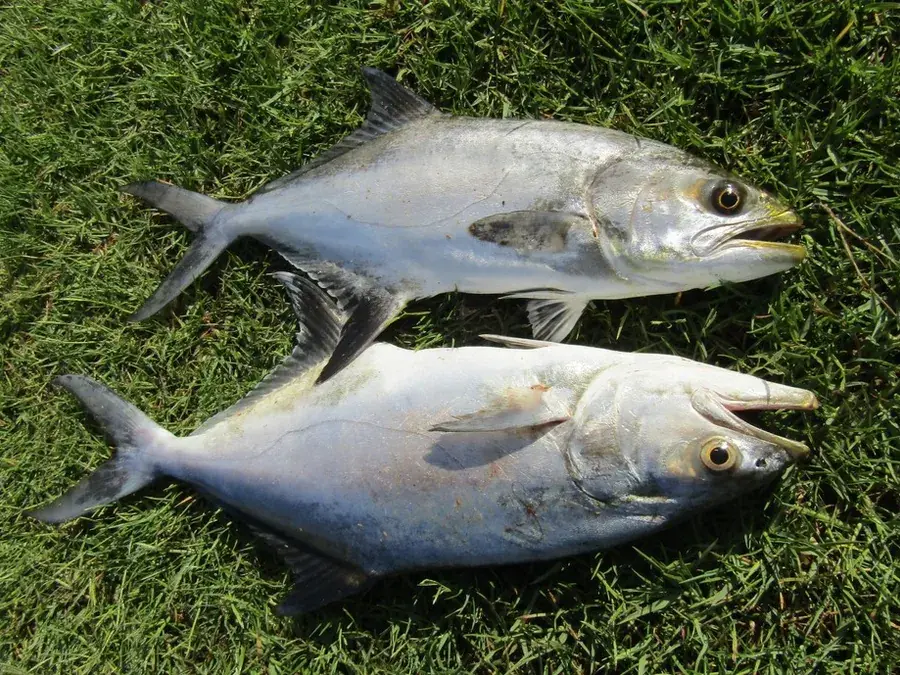
Photo by Justin Ponder on iNaturalist · CC BY 4.0
Leerfish (garrick)
Lichia amia
- When
- Apr–Nov — April, May, June, July, August, September, October, November. Earlier where the water warms first.
- Habitat
- Surf, river mouths and estuaries: in South Africa the estuary mouths and beaches of the Eastern and Western Cape — the Garden Route estuaries among them — in summer, and the KwaZulu-Natal surf in winter; around the Mediterranean, river mouths and rough inshore water such as the Ebro Delta in Spain.
- Identification
- A long, deep, flattened jack, brown above and silver-white below, with a pointed snout and a wildly wavy lateral line that curves up over the pectoral fin and dips behind it. The tips of the dorsal and anal fins are black; it has no hard scutes on the tail.
- Notes
- A surface-feeding predator of mullet and other shoaling fish, rarely more than 500 m from shore. South African adults migrate to KwaZulu-Natal in winter to spawn and return to the Cape for the summer, when they hunt the estuary mouths; in the Mediterranean they are most plentiful in summer.
- Method
- A live mullet swum near the surface at an estuary mouth, or surface plugs and stickbaits worked fast through the surf.
- Caution
- In South Africa two a day at 70 cm or more, on a DFFE recreational permit (online or at the Post Office), and it may not be sold. Females mature at about 85 cm and the South African adult stock has collapsed, so release the big fish. Mediterranean countries set their own minimum sizes — check locally.
Seasons, size limits and catch limits change every year and differ by water body. Check the current regulations for the country and the water before fishing.
Leerfish (garrick) facts
- Also called
- Garrick, leervis or leerie in South Africa; liche in French; leerfish is its FAO and IGFA name.
- Family
- Carangidae, the jacks and pompanos.
- Native range
- The eastern Atlantic from the southern Bay of Biscay to South Africa, including the Mediterranean and the western Black Sea, and up the South African east coast to about Maputo. Scarce between the Kunene mouth and Table Bay; the Namibian–Angolan stock is separate from South Africa’s.
- Habitat
- Near-surface coastal water from the surf zone to about 50 m (165 ft), seldom more than 500 m from shore; it enters estuaries and occasionally the lower reaches of rivers. Eastern and Western Cape estuaries are important nurseries.
- Water temperature
- Warm-temperate to subtropical. AquaMaps puts its preferred surface water at about 18–28°C (64–82°F).
- Size
- Most adults 60–110 cm (24–43 in); the largest measured about 180 cm (71 in).
- Record
- IGFA all-tackle world record: 27.8 kg (61 lb 4 oz), Jose Oriol Ribalta, L’Ampolla, Spain, 30 April 2000. The South African angling record is heavier, at 32.2 kg (71 lb).
- Lifespan
- Up to about 10 years in South African waters.
- What it eats
- Fish — mullet above all, with sardines and other shoaling fish and squid. Young fish also eat crustaceans.
- Spawning
- South African fish migrate to KwaZulu-Natal in winter and spawn there from September to November, probably north of Durban; the eggs and larvae drift south. Fish mature at about four years and 80 cm fork length (85 cm for females).
- Young fish
- Juveniles up to about 12 cm carry brownish-black bars and are common in Cape estuaries and coastal shallows.
- Teeth and mouth
- A large mouth with a slender upper jaw that reaches below or beyond the back of the eye.
- Look-alikes
- Wave garrick (largespot pompano, Trachinotus botla) is bluish-black above with one to five large spots along the lateral line. Bluefish (elf) has a single row of sharp, knife-edged teeth; the garrick’s wavy lateral line is the surest tell.
- Eating
- Eaten around the Mediterranean, where it supports commercial fisheries. In South Africa it is a no-sale species, and WWF-SASSI asks anglers to release it.
- Status
- Least Concern on the IUCN Red List globally, but listed as Vulnerable in South Africa’s 2018 National Biodiversity Assessment; the South African adult stock was assessed in 2008 as collapsed.
Interactive
Leerfish: size range
Move the slider from a typical adult to the largest recorded specimen, shown against objects of known size.
Most adults you'll catch: 60–110 cm (24–43 in).
This leerfish (garrick): 85 cm. Longer than a loaf of bread, shorter than a four-year-old.
The record
IGFA all-tackle world record: 27.8 kg (61 lb 4 oz), Jose Oriol Ribalta, L’Ampolla, Spain, 30 April 2000. The South African angling record is heavier, at 32.2 kg (71 lb).
Questions people ask about leerfish
Is a garrick the same as a leerfish?
Yes. Garrick and leervis are South African names for Lichia amia, the leerfish of Europe — one species found from the Bay of Biscay and the Mediterranean down the West African coast to South Africa.
When are garrick in the Cape estuaries?
Mostly in summer. Adults migrate to KwaZulu-Natal for the winter to spawn, then return to the Cape, where they hunt mullet at estuary mouths such as those of the Garden Route.
What is the size limit for garrick?
In South Africa, 70 cm, with two a day on a DFFE recreational permit, and the fish may not be sold. Females mature at about 85 cm, so releasing fish under that size helps the collapsed stock rebuild.
Found in these regions
Checked against these sources ·
- FishBase — Lichia amia
- Mann (ed.), Southern African Marine Linefish Species Profiles — ORI Special Publication 9 (2013)
- WWF-SASSI — Garrick
- Mr Goodfish — Leerfish
- IGFA — World Records search
- FOSAF — Saltwater fly-fishing report, Garden Route
Sizes, records and ranges are for the species as a whole; local populations and rules vary. Records change; the record-keeper named above holds the current one.
Local activity
This week's guide for a place
Enter a town, postal code or ZIP for this week's conditions there, based on the local climate, this week's weather and the ecological region.
Also active in October
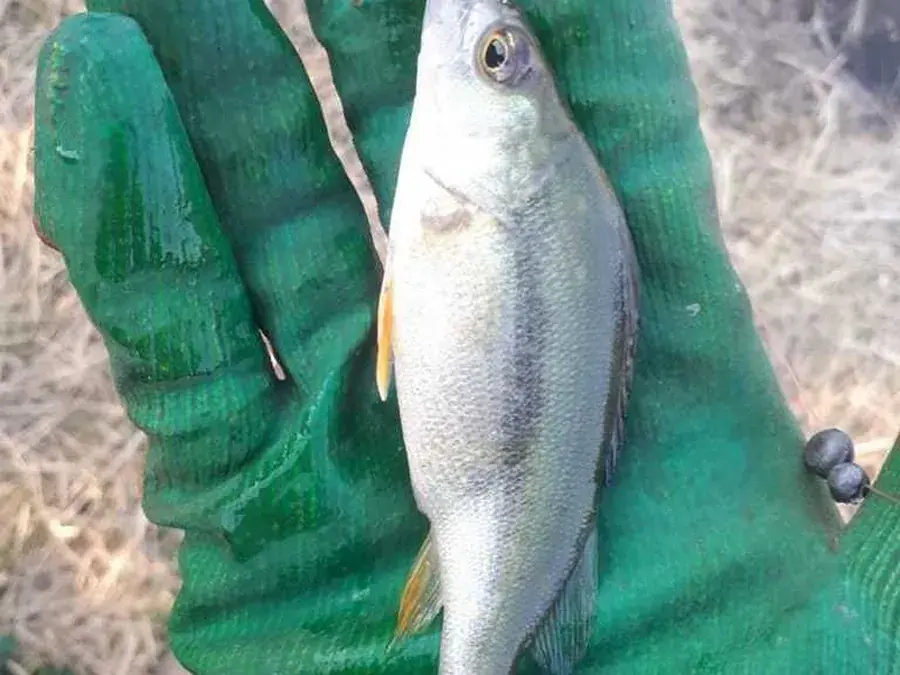 FishJun–Mar
European perch
Perca fluviatilis
Five to eight dark bars on a greenish flank, bright red-orange lower fins, and a spiny first dorsal fin with a black blotch at the back.
Habitat and methods →Photo: Дауд Арсанукаев · CC BY 4.0
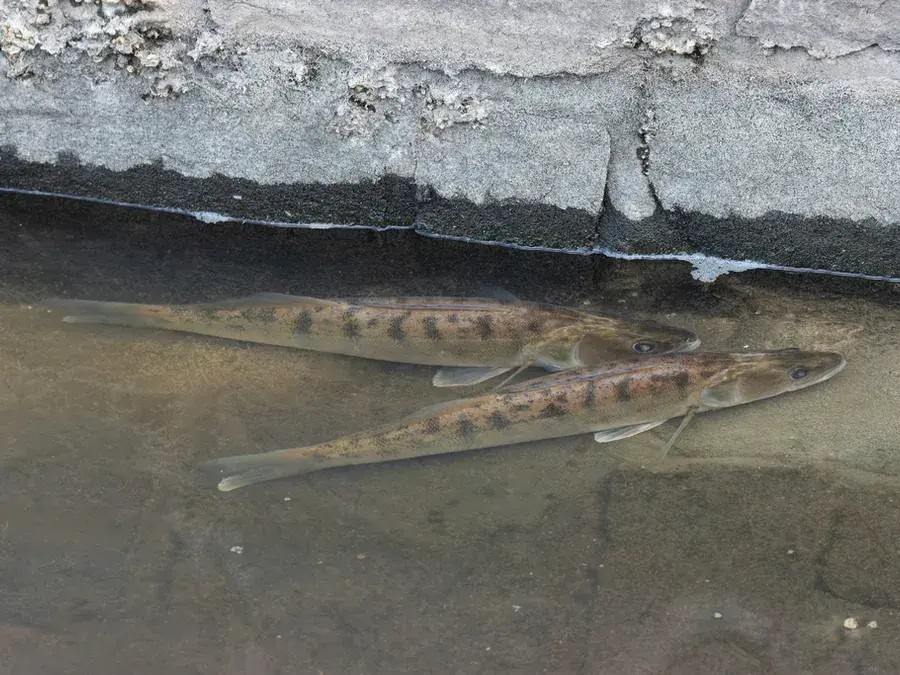 FishJun–Mar
Zander
Sander lucioperca
Slim and glassy-eyed, with grey-brown saddles, rows of black spots on the spiny dorsal fin, and long fang-like canine teeth.
Habitat and methods →Photo: Tomas Broucek · CC BY 4.0
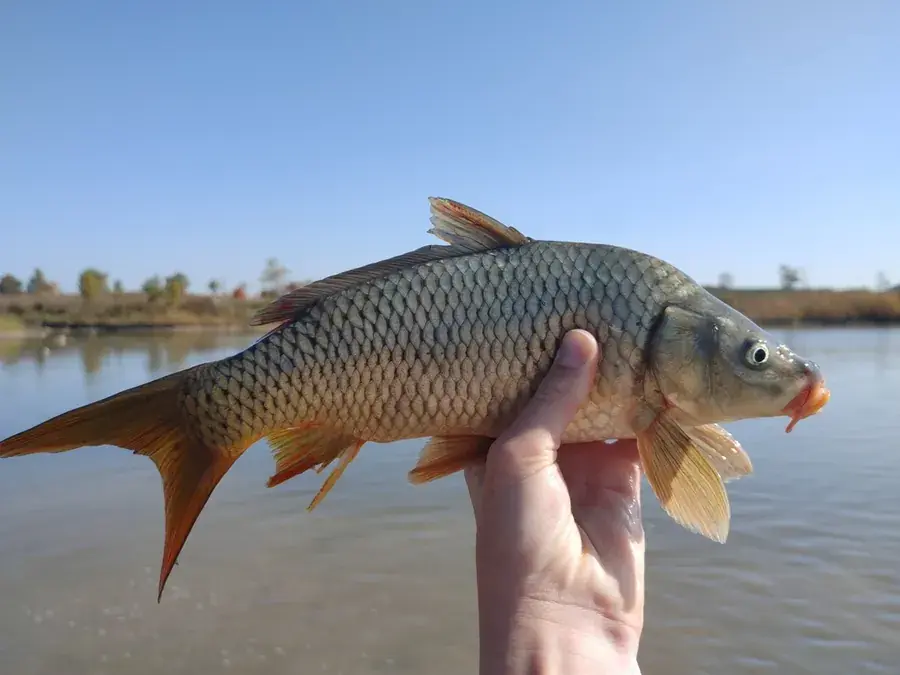 FishApr–Oct
Common carp
Cyprinus carpio
Big bronze scales (or the scattered big scales of a mirror carp), a long dorsal fin, and two pairs of barbels at a rubbery, tube-like mouth.
Habitat and methods →