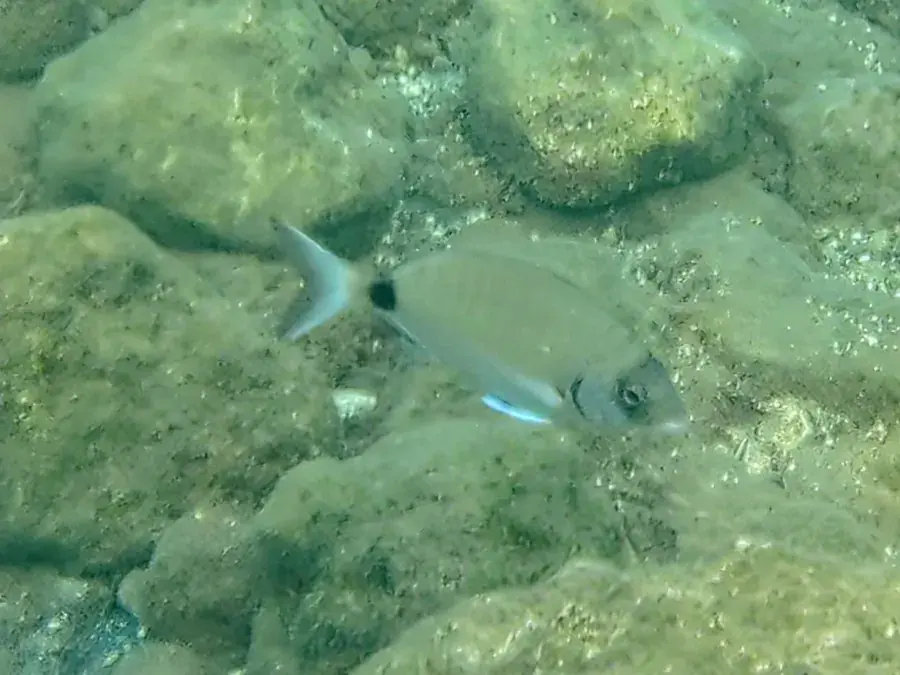
Photo by Public domain (iNaturalist) on iNaturalist · CC0 (public domain)
White seabream (blacktail)
Diplodus sargus
- When
- Active all year; habitat and behaviour shift with the season.
- Habitat
- Rocky shores and the surf beside them — gullies, white water, breakwaters and harbour walls — around the Mediterranean and the Atlantic coasts of France and Iberia, and along the whole South African coast east of Cape Point.
- Identification
- A deep, oval, silver seabream with a big black saddle on the tail stalk. Mediterranean fish carry nine alternating dark and pale bars and a black spot above the pectoral fin; large Cape blacktail are plain silvery-grey, with only faint bars on the young.
- Notes
- The ‘dassie’ of South African rock anglers and the third most commonly caught shore fish on the country’s east and south coasts; the sar or sargo of Mediterranean rock fishing. A resident of its home reef that feeds in the surf at dawn on seaweed, mussels, worms and crabs.
- Method
- A small, strong hook with prawn, mussel or red bait, fished light in the wash close to the rocks.
- Caution
- In South Africa five a day at 20 cm or more, on a DFFE recreational permit (online or at the Post Office), and it may not be sold. European countries set their own minimum sizes — in France 23 cm on the Mediterranean and 25 cm on the Atlantic coast; check local rules.
Seasons, size limits and catch limits change every year and differ by water body. Check the current regulations for the country and the water before fishing.
White seabream (blacktail) facts
- Also called
- Sargo or sar in the Mediterranean; blacktail, dassie or kolstert in South Africa, where WWF-SASSI lists it as Diplodus sargus capensis. FishBase and ORI now treat the southern African fish as a separate species, Diplodus capensis.
- Family
- Sparidae, the seabreams and porgies.
- Native range
- White seabream: the Atlantic from Brittany to Gibraltar, the Mediterranean and the south-western Black Sea. Blacktail: southern Africa in two separate populations — southern Angola and Namibia, and Cape Point east to southern Mozambique — and southern Madagascar.
- Habitat
- Rocky coasts and the surf zone beside them, usually shallower than 50 m (165 ft); Mediterranean fish also use seagrass beds. Young blacktail live in rock pools, gullies, estuary mouths and the surf of sandy beaches.
- Water temperature
- Warm-temperate. AquaMaps puts the Mediterranean fish’s preferred surface water at about 17–23°C (62–73°F) and the Cape blacktail’s at about 16–26°C (60–79°F).
- Size
- Most adults 20–30 cm (8–12 in); the largest measured about 45 cm (18 in).
- Record
- IGFA all-tackle world record (white seabream): 1.87 kg (4 lb 1 oz), Anthony Loddo, Gibraltar Bay, Gibraltar, 28 April 1996. The South African angling record for blacktail is 2.7 kg (6 lb).
- Lifespan
- Up to 10 years for Mediterranean white seabream; Cape blacktail have been aged to 21.
- What it eats
- Seaweed, sponges, mussels and other shellfish, sea urchins, worms, crabs and amphipods.
- Spawning
- Mediterranean fish spawn in early spring (March to May in the Gulf of Tunis). Cape blacktail spawn in small groups on inshore reefs — June to September in KwaZulu-Natal, August to March in the Eastern Cape — and mature at about three years. Some fish change sex as they grow.
- Young fish
- Young fish show faint vertical bars and shelter in rock pools, gullies and estuary mouths.
- Teeth and mouth
- Thin lips, with eight incisor-like teeth at the front of each jaw and rows of molars behind.
- Look-alikes
- In the Cape, zebra (Diplodus hottentotus) carries bold dark crossbars, and galjoen is deeper and heavier with thick lips. In Europe several other Diplodus seabreams share the rocks; the white seabream combines nine alternating bars with the black saddle on the tail stalk and a black spot above the pectoral fin.
- Eating
- A minor food fish in the Mediterranean, where it is also farmed. In South Africa blacktail is a no-sale species, and its flesh is not highly regarded.
- Status
- Least Concern on the IUCN Red List, both as white seabream (2011) and as Cape blacktail (2009).
Interactive
White seabream: size range
Move the slider from a typical adult to the largest recorded specimen, shown against objects of known size.
Most adults you'll catch: 20–30 cm (8–12 in).
This white seabream (blacktail): 25 cm. Longer than a hand, shorter than a loaf of bread.
The record
IGFA all-tackle world record (white seabream): 1.87 kg (4 lb 1 oz), Anthony Loddo, Gibraltar Bay, Gibraltar, 28 April 1996. The South African angling record for blacktail is 2.7 kg (6 lb).
Questions people ask about white seabream
Is a blacktail the same as a white seabream?
Closely related, and long treated as one species: the South African blacktail was described as a subspecies, Diplodus sargus capensis, and WWF-SASSI still uses that name. FishBase and South African scientists now rank it as a species in its own right, Diplodus capensis.
What is the bag limit for blacktail?
Five a day at 20 cm or more, on a DFFE recreational permit. It is a no-sale species.
What is the best bait for blacktail or sargo?
Prawn, mussel or red bait on a small, strong hook, fished light in the white water beside the rocks. It feeds in the surf mostly around dawn.
Found in these regions
Checked against these sources ·
- FishBase — Diplodus sargus
- FishBase — Diplodus capensis
- Mann (ed.), Southern African Marine Linefish Species Profiles — ORI Special Publication 9 (2013)
- WWF-SASSI — Blacktail
- Wikipedia — Diplodus capensis
- Arrêté du 26 octobre 2012 — minimum sizes for French recreational sea fishing (consolidated 2018)
- IGFA — World Records search
Sizes, records and ranges are for the species as a whole; local populations and rules vary. Records change; the record-keeper named above holds the current one.
Local activity
This week's guide for a place
Enter a town, postal code or ZIP for this week's conditions there, based on the local climate, this week's weather and the ecological region.
Also active in October
 FishJun–Mar
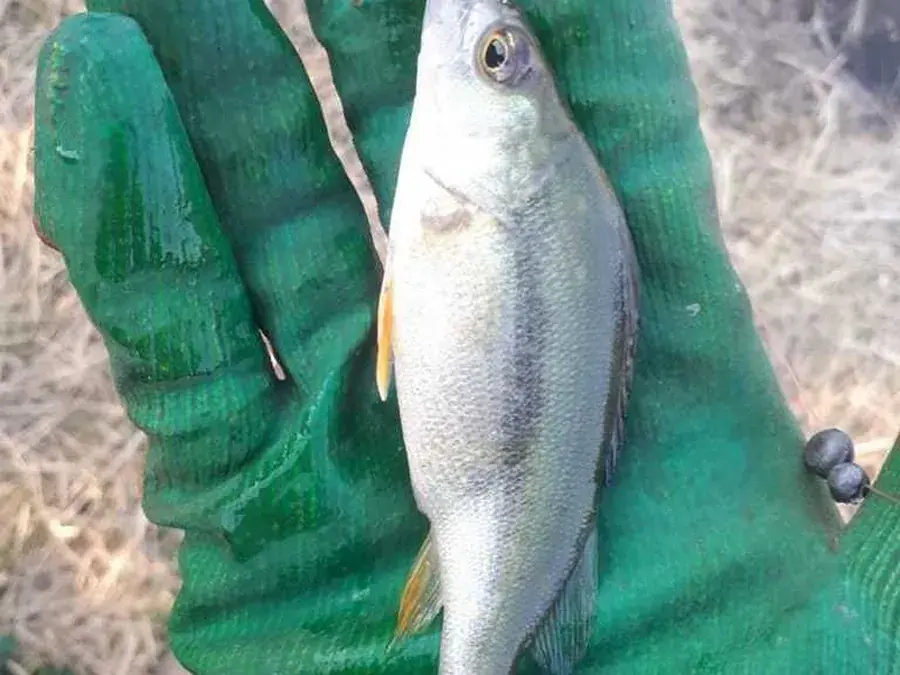
European perch
Perca fluviatilis
Five to eight dark bars on a greenish flank, bright red-orange lower fins, and a spiny first dorsal fin with a black blotch at the back.
Habitat and methods →Photo: Дауд Арсанукаев · CC BY 4.0
 FishJun–Mar
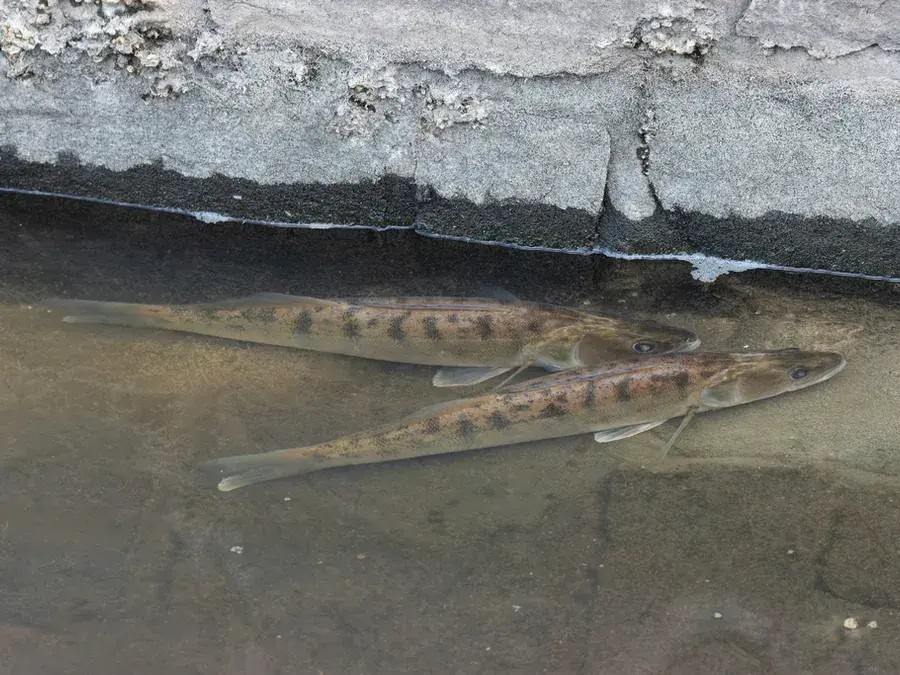
Zander
Sander lucioperca
Slim and glassy-eyed, with grey-brown saddles, rows of black spots on the spiny dorsal fin, and long fang-like canine teeth.
Habitat and methods →Photo: Tomas Broucek · CC BY 4.0
 FishApr–Oct
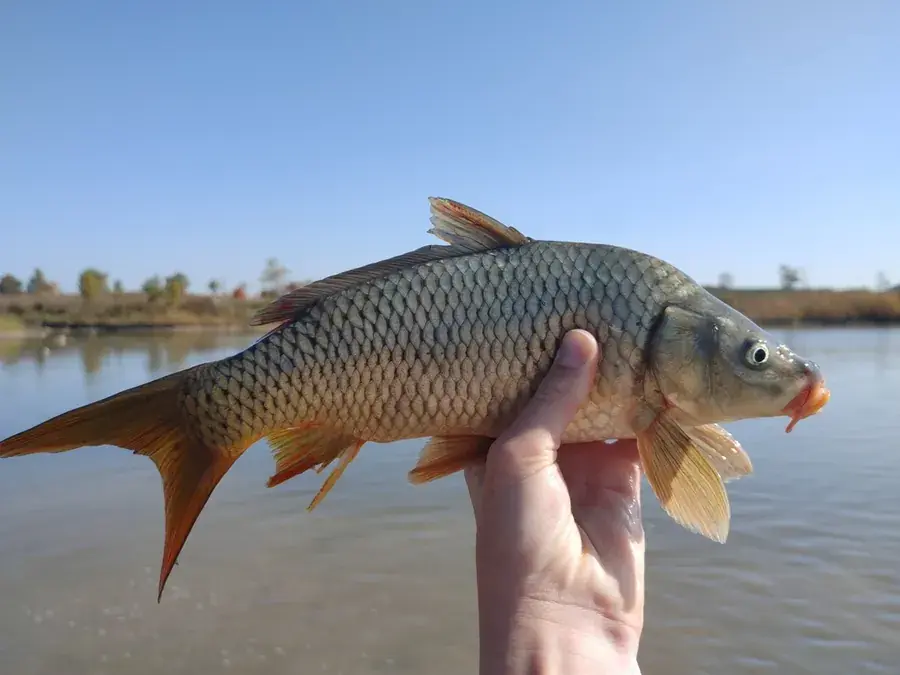
Common carp
Cyprinus carpio
Big bronze scales (or the scattered big scales of a mirror carp), a long dorsal fin, and two pairs of barbels at a rubbery, tube-like mouth.
Habitat and methods →